Get Full Government Meeting Transcripts, Videos, & Alerts Forever!
Get email alerts on the Gift Laws topic
No spam. Unsubscribe anytime.
Ethics staff presents draft gift-law ordinance; commissioners press for stronger enforcement, scenarios and training
Summary
Staff presented draft ordinance and regulations to tighten San Francisco gift rules, make travel gifts subject to the restricted‑source rule and pursue accompanying regulations and training; commissioners urged concrete valuation scenarios, stronger penalties and a clear enforcement plan.
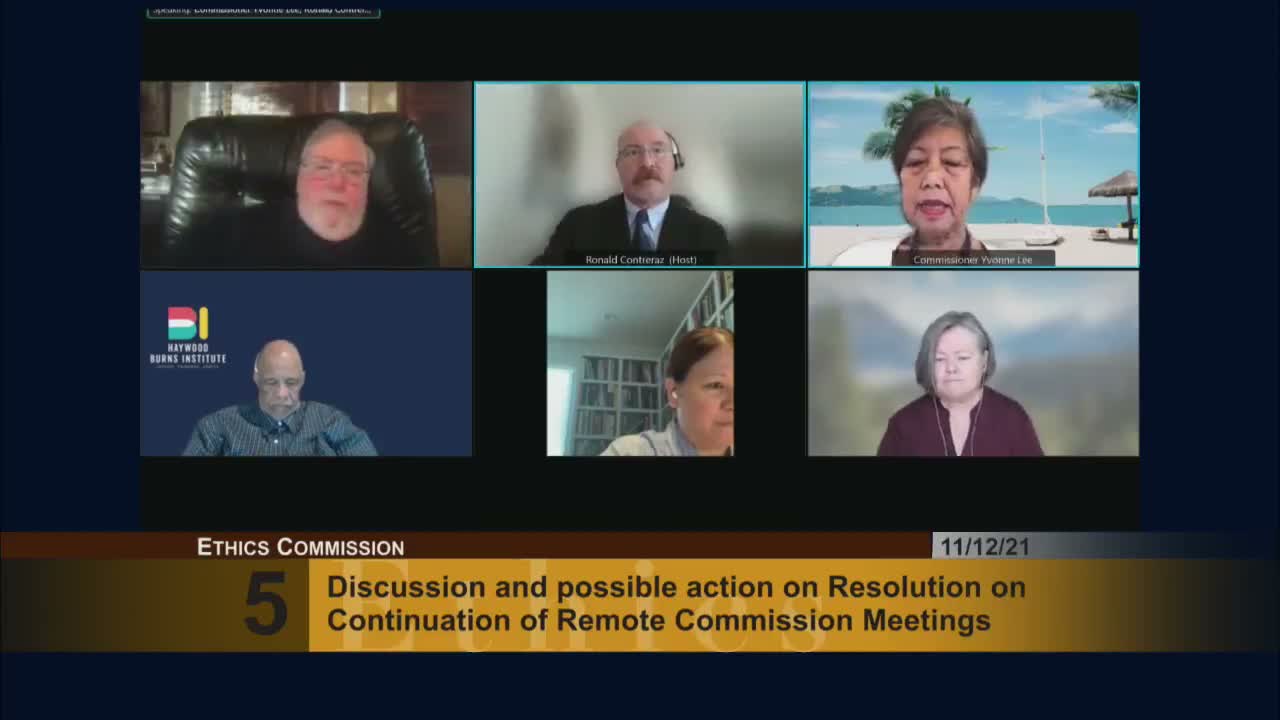
San Francisco Ethics Commission staff presented draft ordinance language and regulation amendments on Nov. 18 to implement recommendations from the office’s two-part "Report on Gift Laws." The package would alter exceptions and tighten rules on gifts to officials and city departments, including making gifts of travel subject to the city’s restricted‑source rule.
Commissioners praised staff work but pressed for greater specificity and enforcement. Commissioner Bush asked the office to include concrete scenarios and valuation guidance — for example, how to value travel upgrades or charter flights — so rules work in real-world situations like sister‑city travel or major event bidding. Commissioner Chiu said the rules should be forward‑looking to prevent future exploitation of loopholes revealed in recent corruption cases and asked what penalties or auditing tools would deter nondisclosure.
Pat Ford, senior policy and legislative affairs counsel, said the draft ordinance removes language that had exempted gifts of travel and wedding gifts from restricted‑source treatment, so restricted sources would generally be disallowed from paying for travel for covered officials. Ford said some technical valuation and attribution details mirror FPPC guidance and that certain fine‑grained rules (for example, how to treat attenuated fundraiser sponsorships) would be most appropriate in subsequent regulations rather than in ordinance text.
On enforcement, Ford said the commission’s recent SARP (streamlined administrative resolution) process, fixed‑penalty authority and planned investigator hires expand the office’s capacity to detect and resolve violations. He added that Phase 3 of the project will address training requirements and penalties and that staff aim to complete meet‑and‑confer with employee bargaining units and the required notice period so the commission could consider action at its December meeting; some code changes affecting the campaign consultant chapter may require a ballot measure in June 2022.
Commissioners asked staff to: - Add factual scenarios and valuation examples (e.g., per‑diem, upgrades, charter flights). - Clarify enforcement tools and propose consistent penalties across code chapters. - Include a statutory training requirement in Phase 3 so education is not solely discretionary.
No formal action was taken on the ordinance at this meeting; staff said they will return with regulatory examples, penalty recommendations and a timeline.