Get Full Government Meeting Transcripts, Videos, & Alerts Forever!
Get email alerts on the Collections Enforcement topic
No spam. Unsubscribe anytime.
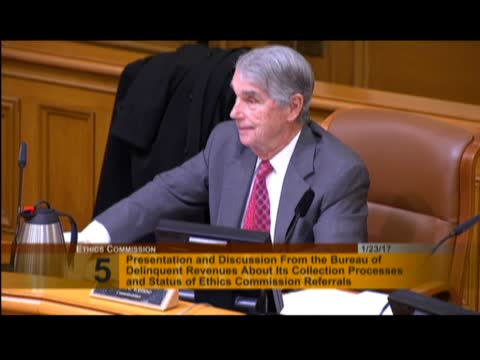
City collections office tells Ethics Commission how unpaid fines are pursued
Summary
The Bureau of Delinquent Revenues described referral criteria, outreach steps, and enforcement tools — from letters and phone calls to small‑claims suits, wage garnishment and long‑term judgment enforcement — and said cases typically move to court about six months after referral when outreach fails.
Officials from the city’s Bureau of Delinquent Revenues (BDR) gave the Ethics Commission an overview of how the city pursues unpaid fines referred by departmental clients.
Jeff Schmeichel, an assistant director at BDR, said referrals generally come after 90 days of delinquency. BDR automatically sends letters within days of referral, attempts phone and email contact, and performs skip tracing for bad addresses. If outreach fails, BDR may set payment arrangements, pursue referral to a collection agency for low‑value debts, or file small‑claims or civil suits for larger balances.
Schmeichel said the office typically targets cases of about $1,000 or greater for an in‑depth asset search, including employment and property records; when those indicators exist the office may demand payment and then, after a 10‑day demand period, pursue litigation or get judgments that can be recorded as liens. Post‑judgment enforcement options include wage garnishment, bank levies and recording abstracts of judgment to surface debts during escrow or refinancing, and judgments can be renewed to keep enforcement options open for up to 30 years.
Commissioners asked about several referrals from the commission, including multiple items related to an individual identified as Chris Jackson; BDR staff reported some matters already have judgments and liens and some remain in asset review or lack contact information, which slows legal action. BDR also said that for many cases the department and BDR collaborate on outreach and will consult the referring agency before making settlements in cases where the agency’s MOU requires it.
BDR staff also said they sometimes defer cases that are uncollectible after repeated searches and that bankruptcy or a debtor’s death can close collection activity; they noted that collection is a manual process for smaller inventories and that judgments and liens are a common tool to obtain payment over time.