Get Full Government Meeting Transcripts, Videos, & Alerts Forever!
Get email alerts on the Ethics Waivers topic
No spam. Unsubscribe anytime.
San Francisco Ethics Commission approves narrow waivers for two commissioners, adopts minutes
Summary
The Ethics Commission unanimously adopted past minutes and granted two narrowly tailored waivers under the city's governmental conduct code: a compensated-advocacy waiver for Commissioner Ruchira Nagaswaran and a post-employment communication waiver for former Historic Preservation Commissioner Aaron Hyland. Both waivers were framed as limited exceptions to specific code provisions.
The San Francisco Ethics Commission on April 8 unanimously adopted past meeting minutes and approved two narrowly drawn waivers to the city's campaign and governmental conduct code.
Chair Ambrose called the meeting to order and the commission first approved the consent calendar — the amended minutes of Feb. 12, 2021, and the draft minutes of March 12, 2021 — by roll call vote. The moderator announced a 5-0 vote in favor of adopting the minutes.
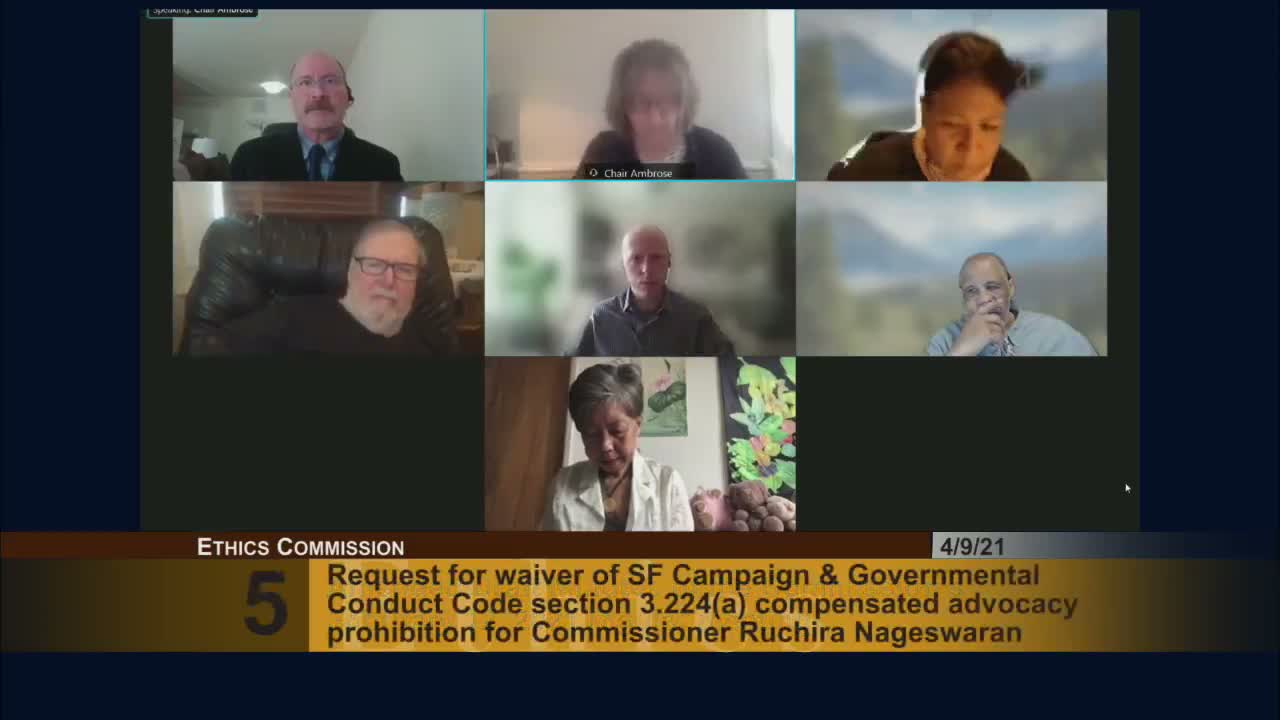
The commission then considered a staff-recommended waiver of San Francisco Campaign and Governmental Conduct Code section 3.224(a), the ban on compensated advocacy, requested by Commissioner Ruchira Nagaswaran. Pat Ford, senior policy and legislative affairs counsel, told commissioners the provision generally bars city officials from receiving compensation in exchange for communications with other city officials intended to influence a government decision but includes a narrow waiver pathway for commissioners appointed to represent particular trades or professions. Ford recommended granting a waiver narrowly tailored to Nagaswaran's described duties. Commissioners Chu and Bush voiced support, emphasizing the importance of recruiting diverse appointees who work in small firms. The commission voted 5-0 to approve the waiver.
Next, the commission addressed a separate request for a waiver of the post-employment restriction in section 3.234(a)(2). That rule prohibits former officials, for 12 months after leaving office, from communicating with their former department on behalf of someone else to influence a government decision. The applicant, Aaron Hyland, a former member of the Historic Preservation Commission, said he seeks to communicate with Planning Department staff in the course of his private architectural practice but would not present before his former commission. Staff again recommended a narrowly crafted waiver limited to the circumstances described. After questions about scope, the commission approved the waiver; roll call reflected four affirmative votes with Commissioner Bell marked excused at the time of that vote (the transcript record shows the motion approved unanimously among those voting).
Votes at a glance: - Consent calendar (minutes of Feb. 12 and March 12): approved, roll call 5-0. - Waiver request — Campaign and Governmental Conduct Code —ECTION 3.224(a) (compensated advocacy) for Commissioner Ruchira Nagaswaran: approved, roll call 5-0. - Waiver request — Campaign and Governmental Conduct Code —ECTION 3.234(a)(2) (post-employment restriction) for Aaron Hyland: approved; transcript shows four recorded affirmative votes with one commissioner excused during the roll call.
Chair Ambrose thanked the applicants and commissioners for their service. There were no callers in the public comment queues for the waiver items; staff noted the commission will continue to refine waiver language to be narrowly tailored to each requester's circumstances.
The meeting record shows each waiver was discussed with attention to limiting scope and avoiding the creation of broad exceptions to the code; staff repeatedly emphasized the recommendations were intended to be narrowly tailored to the applicants' professional situations.