Get Full Government Meeting Transcripts, Videos, & Alerts Forever!
Get email alerts on the Budget Staffing topic
No spam. Unsubscribe anytime.
Ethics Commission warns budget cuts could eliminate about a quarter of staff
Summary
The San Francisco Ethics Commission cautioned that mayoral FY22 budget instructions requiring roughly a 10% reduction, combined with attrition, could force elimination of about 6–7 positions — roughly a quarter of the commission’s staff. Commissioners discussed outreach, work orders for training, and alternative funding ahead of a special Jan. 21 meeting.
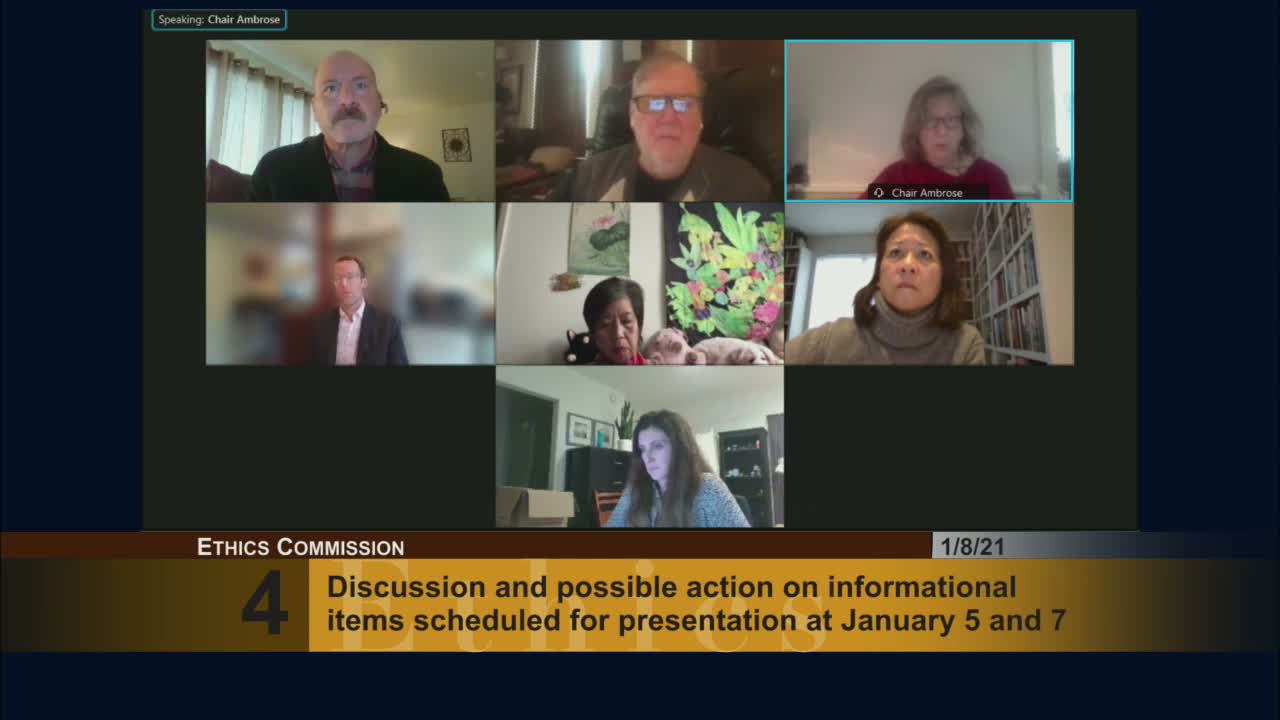
The San Francisco Ethics Commission on Jan. 8 warned that mayoral budget instructions and a projected city shortfall could force deep staffing reductions that would affect the agency’s enforcement and oversight work.
Executive Director Pelham said the mayor’s guidance requires a mandatory 7.5% reduction plus a 2.5% contingency — effectively about a 10% cut — and that, in combination with attrition, “this could translate to at this point the elimination of approximately 6, excuse me, 6 to 7 commission positions,” representing roughly a quarter of the office’s staff. Pelham also outlined recent personnel moves, saying the office has made two internal promotions (Tyler Field and Jared Flores) and is continuing recruitments with a goal of filling seats by March 1.
Why it matters: Commissioners said the cuts would have outsized effects on a small enforcement office that has no independent revenue stream. Commissioner Chiu said a flat 10% reduction would “disproportionately impact” a small department and urged staff to show, in detail, which programs and services would be lost if positions are cut. Commissioner Bush urged the Commission to present precise metrics to the public — for example, the number of investigators needed to reach timelier case closures — and warned that long investigation timelines would undermine public confidence.
The director’s report also covered staff work on the Commission’s Racial Equity Action Plan (submitted to the City’s Office of Racial Equity) and progress on implementing 16 recommendations from the Budget and Legislative Analyst audit. Pelham said two of the audit’s items (a training plan and a case closure plan) were complete, with other recommendations planned or underway.
Commissioners proposed a range of responses. Several urged more aggressive public outreach and suggested a targeted communications push before the City’s budget hearings to highlight the Commission’s role and the consequences of cuts. Commissioner Lee suggested broadening outreach to community media and invited the press to the upcoming interested-persons meetings. Commissioners also discussed nontraditional funding avenues: using work orders from enterprise departments to pay the Commission for compliance training or Form 700 services, and considering solicited donations for narrowly defined activities.
Next steps: Pelham said staff will schedule a special meeting to hear departmental budget priorities on Jan. 21 and noted interested-persons meetings on proposed revisions to the fixed-penalty policy on Jan. 26 and Jan. 28. No formal budget decisions were taken at the Jan. 8 meeting; commissioners asked staff to prepare specific impact analyses and agenda language for the Jan. 21 and subsequent meetings so the public and the mayor’s office can see the potential programmatic effects of cuts.
Quotes in context: Commissioner Chiu said a 10% cut “to me says that the city is not serious about rooting out corruption,” reflecting concern that reduced capacity would limit enforcement. Commissioner Bush recommended the Commission document concrete examples — such as average investigation timelines and staffing benchmarks — to make an evidence-based case for maintaining resources.
The Commission did not vote on budget actions during the meeting; the next substantive opportunities for public input are the Jan. 21 special meeting and the Jan. 26 and Jan. 28 interested-persons sessions.