Get Full Government Meeting Transcripts, Videos, & Alerts Forever!
Get email alerts on the Behested Payments topic
No spam. Unsubscribe anytime.
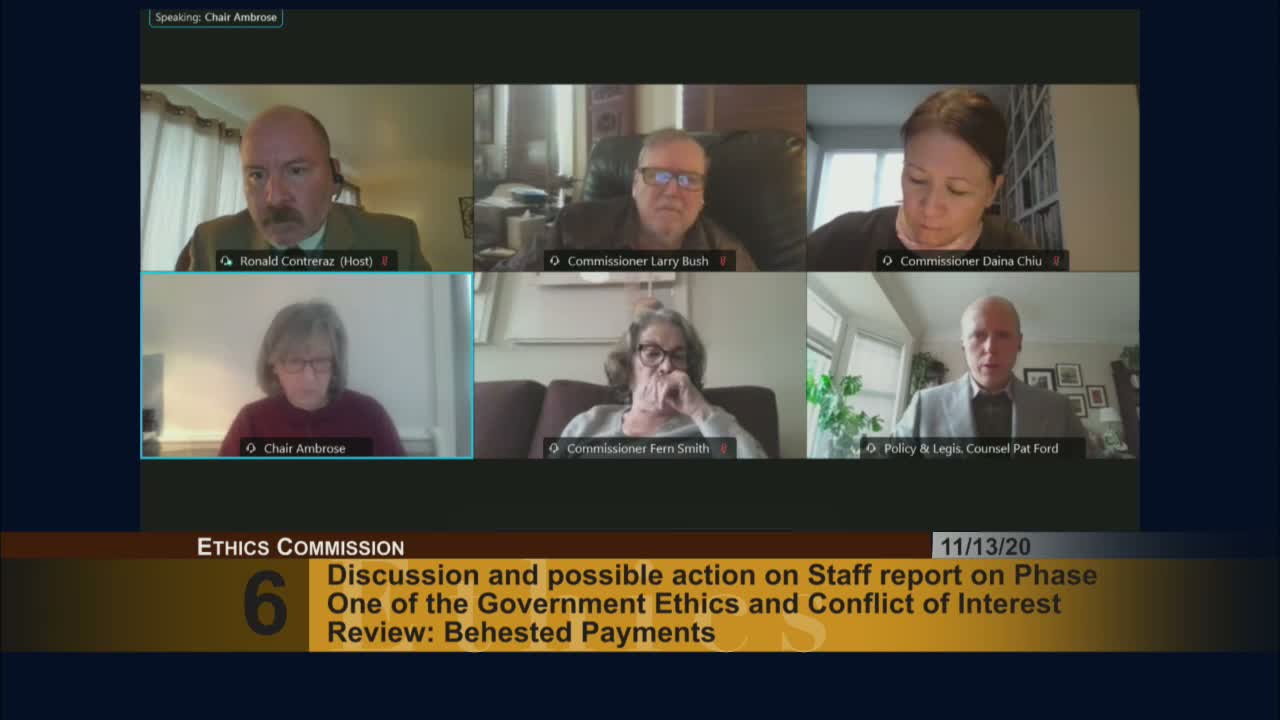
Ethics Commission endorses staff recommendation to bar officials from soliciting 'behested' payments from interested parties
Summary
The Ethics Commission voted unanimously Nov. 5 to authorize staff to tell the Board of Supervisors it supports prohibiting city officials and employees from soliciting behested payments from 'interested parties' (contractors, permit applicants, lobbyists and restricted sources), while preserving an exception for established city gift funds and continuing stakeholder outreach.
The Ethics Commission on Nov. 5 voted unanimously to authorize staff to tell the Board of Supervisors the Commission supports at least an initial prohibition on city officials and employees soliciting 'behested' payments from interested parties — a policy staff recommended after reviewing examples tied to the federal Nuru investigation and other cases.
Pat Ford, senior policy and legislative affairs counsel for the Ethics Commission, said the staff review found behested (’behest’) payments carry a high risk of pay‑to‑play and can be used as an end‑run around existing gift and contribution rules. He said the staff's principal recommendations are: (1) prohibit officials and employees from soliciting behested payments from interested parties (defined to include contractors with existing or pending business, permit or entitlement applicants, registered lobbyists and restricted sources); and (2) prohibit directing behested payments to organizations that provide a source of income to an official or an official’s spouse.
"We believe they should be included in the same kind of rules that apply to gifts and contributions," Ford told the Commission, describing examples in which public‑works employees asked contractors to direct payments to nonprofits, accounts or foundations that ultimately benefited departmental staff.
Commissioners debated scope and enforcement. They asked whether the rule would (a) sweep too broadly and unintentionally constrain legitimate nonprofit fundraising, (b) withstand First Amendment concerns if applied to non‑contracting charitable appeals, and (c) appropriately define "interested parties." Staff and the Commission agreed to build in exceptions for broad public appeals and to pursue stakeholder outreach to the nonprofit and contracting communities to refine definitions and compliance guidance.
During public comment, Debbie Lerman of the San Francisco Human Services Network urged caution and nuance, warning that many nonprofit contractors could be unintentionally hampered by an overly broad restriction and asked the Commission to provide clear public‑appeal exceptions and outreach to nonprofit partners.
The Commission’s final motion (moved by Chair Ambrose and seconded by Commissioner Smith, amended during debate to include "including but not limited to" language in the staff list of interested parties) authorized staff to communicate support for the proposed restriction to the Board of Supervisors while continuing stakeholder engagement and reserving the right to refine definitions and exceptions. The motion passed on a unanimous roll call vote, 5–0.
Next steps: Staff will coordinate with Supervisor Haney’s office and the City Attorney’s office as legislation moves at the Board of Supervisors, continue outreach to nonprofit contractors and departmental stakeholders, and return to the Commission with refined language and compliance materials.