Get Full Government Meeting Transcripts, Videos, & Alerts Forever!
Get email alerts on the Enforcement topic
No spam. Unsubscribe anytime.
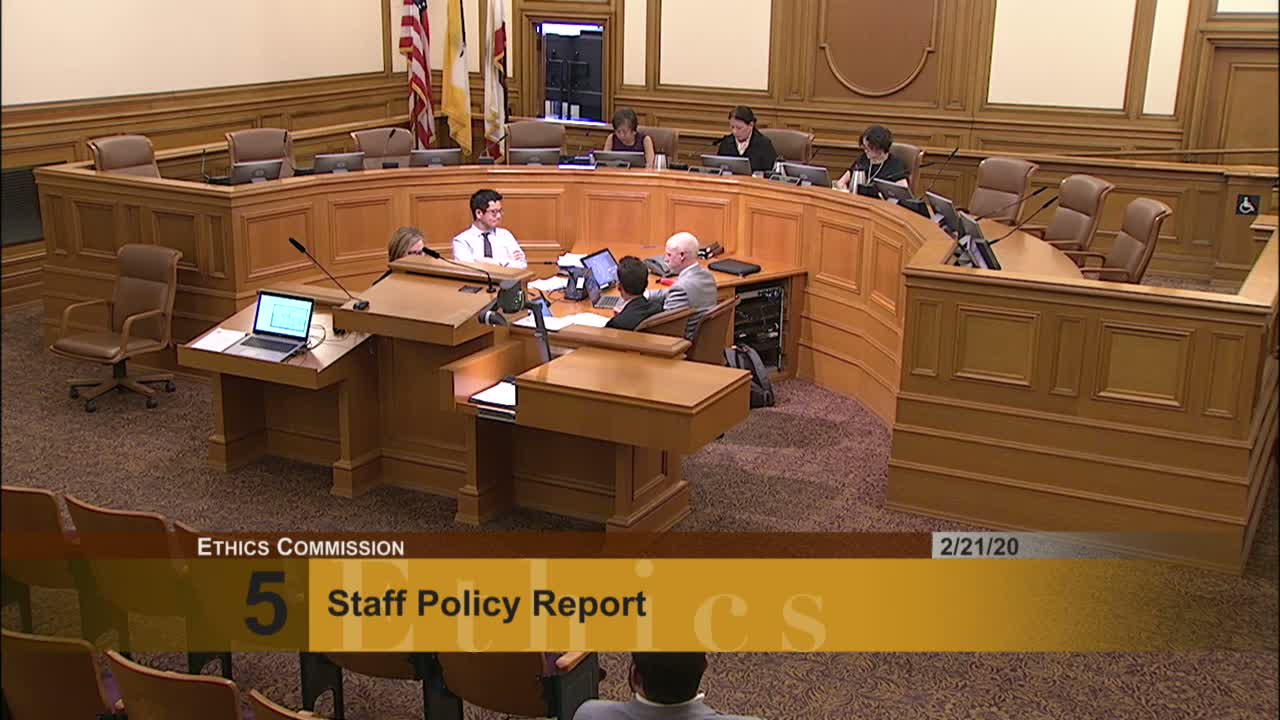
Commission details enforcement workload and online complaint tool; moves into closed session on pending litigation
Summary
Staff reported coordination with other city investigative offices, an online complaint submission tool that will allow anonymous informal and formal sworn complaints, and long investigation timelines; a motion to assert attorney‑client privilege to meet in closed session on pending litigation passed unanimously.
Enforcement staff told the Ethics Commission that it continues to coordinate weekly with investigative counterparts in the city attorney, controller and district attorney offices in light of recent revelations, including the federal indictment of a former public works director.
Staff highlighted the development of an online complaint submission tool designed to replicate current complaint options: anonymous informal submissions, informal submissions with contact information but without attestation, and the option to submit formal sworn complaints attesting to veracity. The staff member said the tool is mid‑development and may be launched initially as a pilot to solicit user feedback.
The enforcement report also noted that a majority of matters are in open investigation and that the average time to resolve an open investigation is holding around 18 months, while the triage step for new complaints is trending under six months. Staff said they will work with policy and other divisions to identify legal vulnerabilities in areas such as gifts, debt payments and incompatible‑activity statements.
Public commenters, including Ray Hartz of San Francisco Open Government, sharply criticized the commission’s enforcement record and urged more aggressive action and transparency. Staff responded by pointing to active investigations and the work under way to expand complaint intake and enforcement processes.
Later in the meeting, the commission unanimously adopted a motion to assert attorney‑client privilege and to meet in closed session under the Brown Act and the Sunshine Ordinance to discuss pending litigation related to Proposition B et al. The commissioners voted to go into closed session and briefly adjourned for a five‑minute break.