Get Full Government Meeting Transcripts, Videos, & Alerts Forever!
Get email alerts on the Public Financing topic
No spam. Unsubscribe anytime.
Ethics office rolls out public‑financing reforms and expanded candidate guidance ahead of 2020 elections
Summary
After a two‑phase review, the commission finalized ordinances and regulations changing public‑financing mechanics (including raising matching ratios and adjusting matching caps), updated NetFile and published expanded supplemental guides and a visual presentation to help candidates and treasurers comply.
The Ethics Commission presented the culmination of an 18‑month public‑financing review that officials say will reduce compliance burdens and broaden candidate access to the city’s public financing program ahead of the 2020 election cycle.
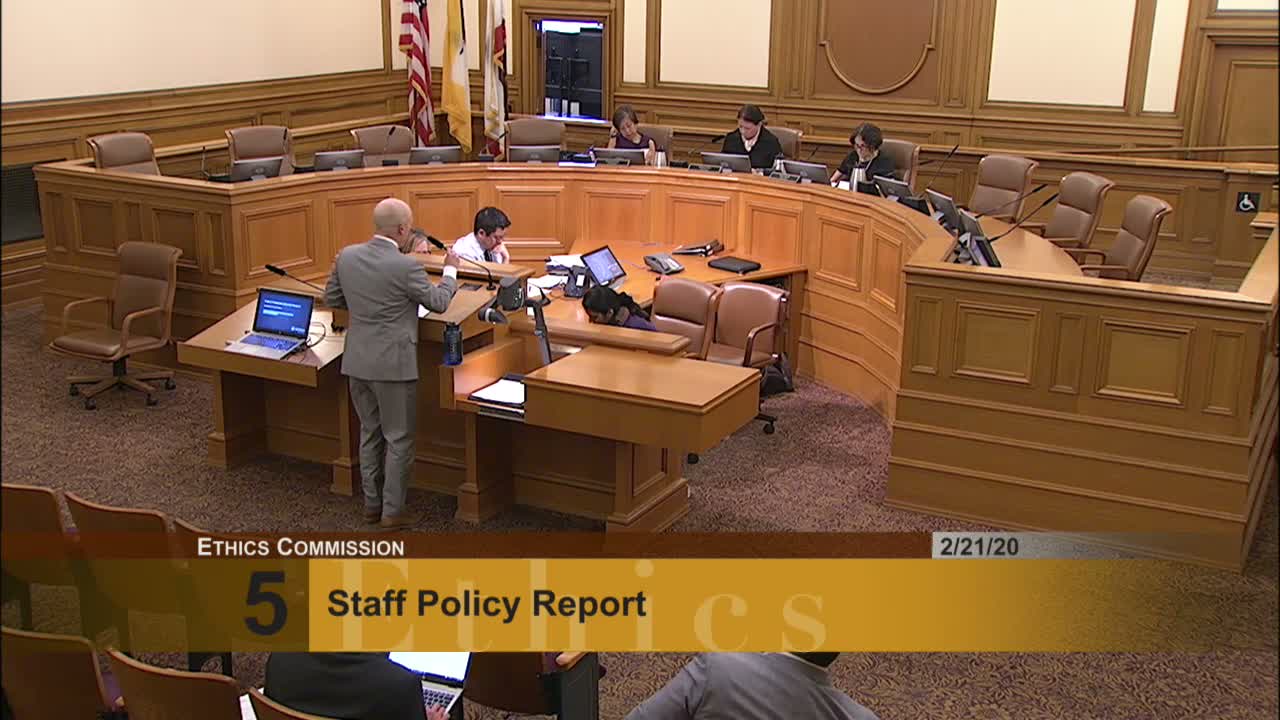
Pat Ford, senior policy and legislative counsel, recapped the review’s twin goals: simplify participation for candidates and strengthen program outcomes. Phase 1 produced an ordinance and regulations that clarified procedures, changed the statement‑of‑participation deadline, eliminated the trust‑account and contingency‑account requirements, and clarified residency verification and appeal standards.
Phase 2 adjusted the program’s matching mechanics and funding levels. Ford said the matching ratio was increased from 2:1 to 6:1, but the match is no longer calculated against a full $500 contribution; matching now applies up to $150 of a contribution. The changes aim to make matching funds more broadly available and adjust initial independent expenditure contingency (IEC) levels.
Rob Hodge, the commission’s lead auditor, described implementation work: public‑financing content on the commission website was expanded; NetFile systems were updated to reflect ordinance changes; and the office expanded supplemental guides to roughly 30 pages. Hodge said the commission produced a new visual presentation to accompany the dense written material and plans both in‑person and web‑hosted training for candidates and treasurers.
Commissioners praised flowcharts and the new visual presentation as helpful tools for first‑time candidates. Staff said the phase 2 changes were published in January and will apply to the November 2020 election cycle, and they plan to conduct a brief look‑back in early to mid‑2021 to evaluate results and identify possible refinements.