Get Full Government Meeting Transcripts, Videos, & Alerts Forever!
Get email alerts on the Enforcement topic
No spam. Unsubscribe anytime.
Enforcement staff outline expanded fixed-penalty program and collections update from BDR
Summary
Enforcement staff proposed a streamlined administrative resolution program (SARP) to expand fixed-penalty dispositions to roughly 35 violation types across campaign finance, lobbying and conflicts rules; the commission also heard from the Bureau of Delinquent Revenue on collection practices, including a typical $1,000 threshold for escalated collection and the bureau’s use of skip-tracing and payment-plan agreements.
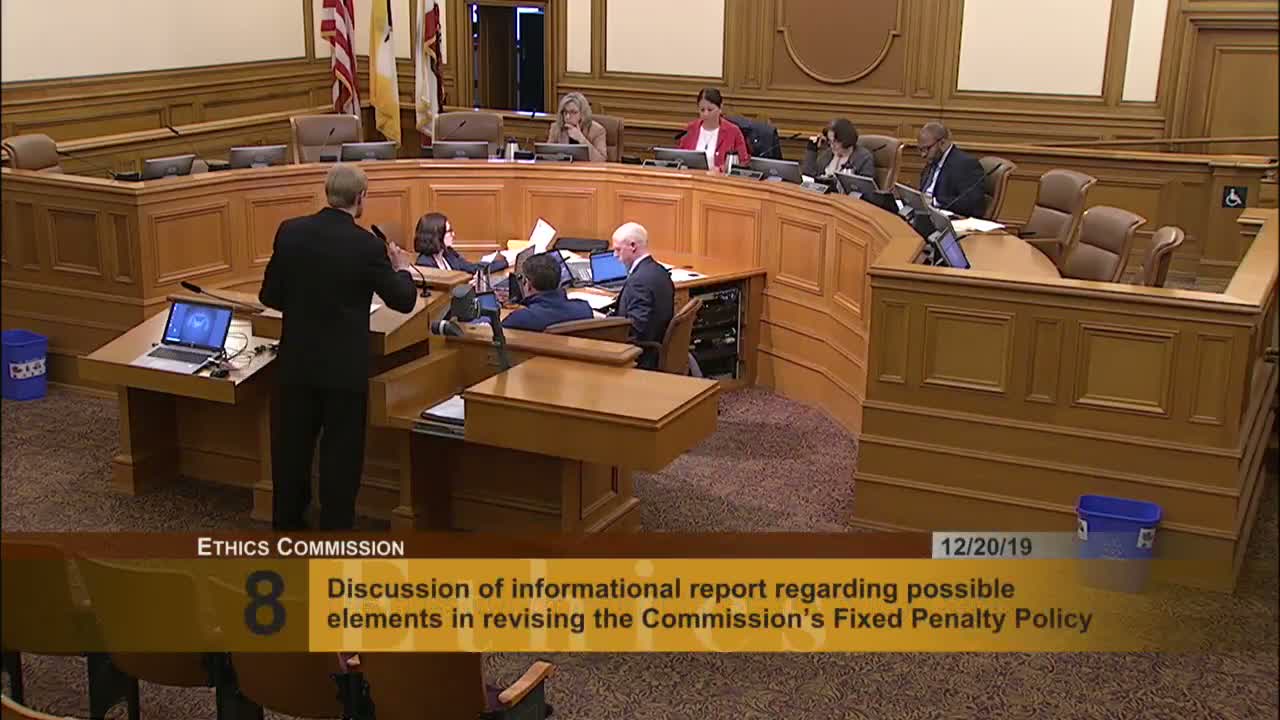
Eric Willett, a senior investigative analyst in the Ethics Commission’s enforcement division, outlined a proposal to expand the commission’s existing fixed-penalty program into a Streamlined Administrative Resolution Program (SARP). Willett said staff reviewed other jurisdictions and stakeholder input and preliminarily identified about 35 violation types from the Campaign Finance Reform Ordinance (CFRO), lobbying ordinance and conflict-of-interest code that could be eligible for standardized penalties and faster resolutions. He said exclusions would include evidence of intent to conceal, failure to cooperate, repeat offenders, or conduct causing more-than-minimal public harm, and that staff expect to draft detailed eligibility criteria and penalty ranges in early 2020.
Commissioners asked whether dispositions under a fixed-penalty program would be memorialized publicly and suggested a public register of warning letters and fixed penalties to ensure transparency and build staff protection against claims of inconsistent treatment; Willett said staff plan to include disposition categories and thresholds in draft enforcement regulations.
On the enforcement operations update, Jeff Zumwalt introduced Jeffrey Schmeichel, director of the Bureau of Delinquent Revenue (BDR). Schmeichel described BDR’s approach to prioritizing accounts for collection — assessing collectability, available information, and potential value — and said the bureau typically applies full legal collection effort to accounts of $1,000 or more while lower-balance accounts receive standard collection outreach and may be referred to private collection agencies. He explained the bureau’s skip-tracing tools (LexisNexis, DMV records, social media), use of formal payment-plan agreements and the ability for the commission to recall accounts from BDR for renegotiation if necessary. Commissioners requested monthly reports and clearer criteria for when staff will escalate or recall accounts.
Willett and enforcement staff said they will hold additional interested-persons meetings in January and February 2020 to get stakeholder feedback on the SARP drafting and will return with a detailed proposal for commission review.