Get Full Government Meeting Transcripts, Videos, & Alerts Forever!
Get email alerts on the Procurement topic
No spam. Unsubscribe anytime.
Controller finds gaps in Public Works contracting, recommends tighter procurement and ethics controls
Summary
The city controller's preliminary assessment identified weaknesses in Public Works procurement, limited external oversight and uneven use of competitive solicitation, and recommended central oversight, revised procurement procedures for homelessness projects and closing gift-reporting loopholes. The Ethics Commission pledged to work on fixes and training.
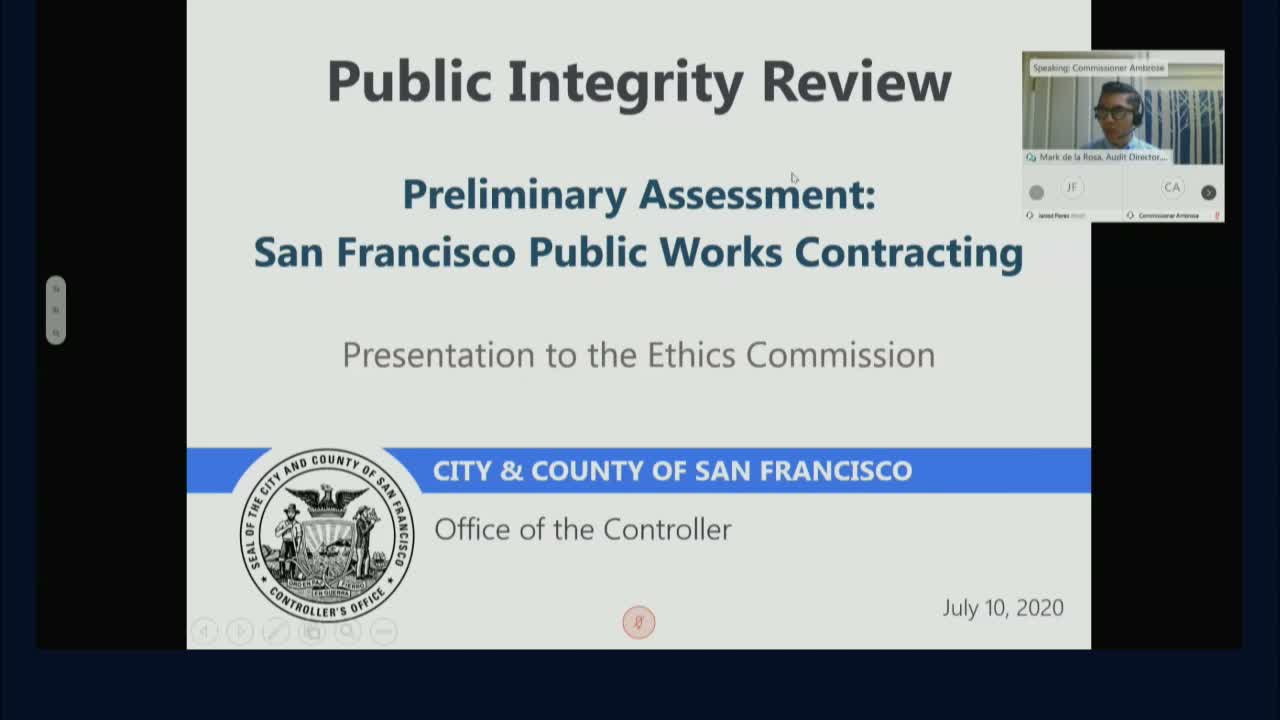
The San Francisco controller's office presented a preliminary assessment on June 29 that flagged systemic weaknesses in the Department of Public Works's contracting and recommended a mix of administrative and legal fixes.
The report, summarized to the Ethics Commission by Mark De La Rosa, acting director of audits, said Public Works let 366 contracts from 2017 through 2020 totaling about $1.4 billion, and that a subset of contracts tied to homelessness projects were awarded under a waiver provision of the administrative code without documented selection processes. "For public works alone there were 15 contracts that fell under these categories of projects addressing homelessness that totaled $24,600,000," De La Rosa said, and staff could not find documentation for selection in many cases.
Why it matters: The controller recommended several changes aimed at strengthening oversight and reducing opportunities for favoritism: (1) restore an external approval layer for chapter 6 procurements rather than allowing department heads to make high-dollar approvals by delegation; (2) require consistent procedures and documentation for competitive and prequalified pools; (3) tighten grant procurement rules; and (4) close gift-reporting and Form 700 filing loopholes that the controller said could allow officials to conceal conflicts.
The Ethics Commission responded that it will review whether local rules and enforcement practices need amendment and requested funding to expand electronic Form 700 filing and enforcement capacity. Executive Director Pelham told commissioners that the office has recommended e-filing and additional compliance staff in its February budget submission but that the FY21 cuts would delay implementation.
What the report found: De La Rosa highlighted several patterns that created risk: limited external oversight of Public Works (unlike other chapter 6 departments), repeated selection of the same vendors from prequalified pools without documented selection criteria, and an administrative-code provision (chapter 21B, section 6.76) that allowed departments to waive competitive solicitation for homelessness projects. "Given this waiver, the usual controls that you would see in terms of minimum solicitation, vendor qualifications, fair selection, were not uniformly applied," he said.
Controller's recommendations and next steps: The controller urged the mayor and Board of Supervisors to amend chapter 6 to limit mayoral delegation; expand central oversight and consistent use of the citywide procurement system; require minimum grantprocurement standards; and provide funding and legal changes so Form 700 filings are electronic and auditable. The controller's office said its work is preliminary and that findings may be refined as investigations continue.
The Ethics Commission said it would work with the controller and city attorney on regulatory and training responses and urged funding to expedite e-filing and enhanced audits. The commission also directed staff to help draft a letter to the Board of Supervisors urging preservation of key budgeted positions and the February FY21 requests in light of the controller's findings.
The controller's report is preliminary and the city attorney and federal investigations are ongoing; specific contract reversals or criminal outcomes are decisions for prosecutors and courts.