Get Full Government Meeting Transcripts, Videos, & Alerts Forever!
Get email alerts on the Campaign Finance topic
No spam. Unsubscribe anytime.
Ethics Commission adopts Prop F regulations tightening disclosures and banning some land-use contributions
Summary
The San Francisco Ethics Commission unanimously adopted a package of regulatory amendments to implement Proposition F, updating public-financing ceilings, expanding contribution prohibitions for land-use interests, increasing disclaimer detail and font size, and requiring itemized cost breakdowns for certain independent expenditures. Staff will publish guidance for compliance and begin implementation in early 2020.
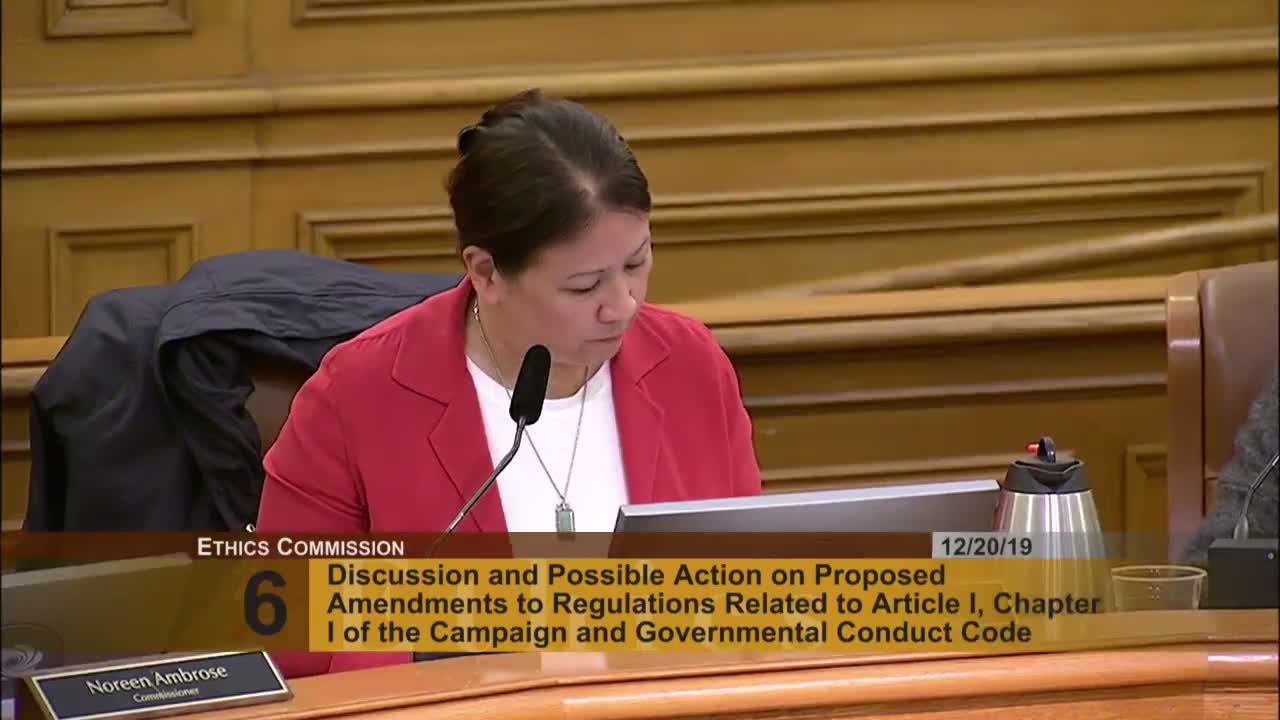
The San Francisco Ethics Commission voted unanimously to adopt a set of regulatory amendments implementing Proposition F and related public-financing updates, commissioners said at a meeting in late December 2019.
Pat Ford, senior policy and legislative affairs counsel to the commission, told the panel the package combines two projects: updates to public-financing mechanics and a broader set of changes required by Prop F. Ford said the package raises the individual expenditure ceiling (IEC) starting levels — from $250,000 to $350,000 for supervisorial candidates and from $1,475,000 to $1,700,000 for mayoral candidates — and adjusts example calculations in the regulations to reflect the new thresholds.
The adopted rules also implement several seven key Prop F provisions. They expand the city’s corporate-contribution prohibition to cover limited liability partnerships and limited liability companies, establish a new ban (CFRA section 1.127) on contributions to mayor, supervisor and city attorney candidates by persons with a financial interest in a land-use matter, and require certain departments to post public notices about the rule. The regulations clarify that primary residences are exempt and set a financial-interest threshold of $5,000,000 (or projects with estimated construction costs of $5,000,000 or more) for the prohibition to apply.
Prop F’s advertising and independent-expenditure rules are reflected in the changes. Ford said the regulations adopt a lower disclosure threshold (about $5,000) for top contributors, require the dollar amount for each named contributor to be listed in disclaimers, and, when a named contributor is itself a committee, require disclosure of up to two of that committee’s top contributors (and their dollar amounts). The rules also raise the required font size for disclaimers to 14-point and require that, during the 90-day late-reporting period before an election, committees file itemized cost breakdowns (photography, design, printing, postage, and similar line items) on the existing Form 496 (the late independent-expenditure report).
Ford also described technical clarifications adopted as amendments read into the record by staff and stakeholders: allowing good-faith cost estimates on Form 496 (with a 48-hour amendment window after invoices arrive), permitting contributor attestations to be provided electronically to trigger the land-use safe harbor, adding a statutory cross-reference to define “land use matter,” clarifying how partnerships with business-entity members may use separate segregated funds, and aligning defined terms such as “discretionary review hearing.” Anita Mayo, a municipal practice attorney who submitted written comments, told commissioners the proposed edits “will provide clarity to the regulations.”
Commissioners moved to adopt the six staff-read amendments and then to adopt Attachment 1 to the agenda item as modified. The chair announced both motions carried unanimously.
Ford and other staff said they will publish guidance and worked with the city attorney and planning staff during drafting. Staff also flagged implementation tasks: NetFile (the city’s free filing system) will require operational changes to support some new reporting fields, and staff plan to publish user guidance and materials to help committees provide the required attestations and cost breakdowns. The commission directed staff to return with additional implementation details and to make materials available online ahead of the rules’ effective dates.
The commission’s action formalizes regulatory details voters approved under Proposition F and places a number of new compliance and disclosure obligations on political committees, independent-expenditure filers and departments that handle land-use matters. The commission and staff said they expect to begin implementation work immediately and to complete systems work and guidance around the start of 2020.