Get Full Government Meeting Transcripts, Videos, & Alerts Forever!
Get email alerts on the Public Financing And Disclosure topic
No spam. Unsubscribe anytime.
Commission briefed on public‑financing ordinance progress and Form 700 e‑filing timeline
Summary
Staff reported the Board of Supervisors approved the city's public financing ordinance on first reading and that the commission is preparing for implementation; staff also outlined a Form 700 e‑filing project targeting Jan. 1, 2021, and flagged a Third District Court of Appeal decision affecting general‑law cities' public financing statutes (not San Francisco).
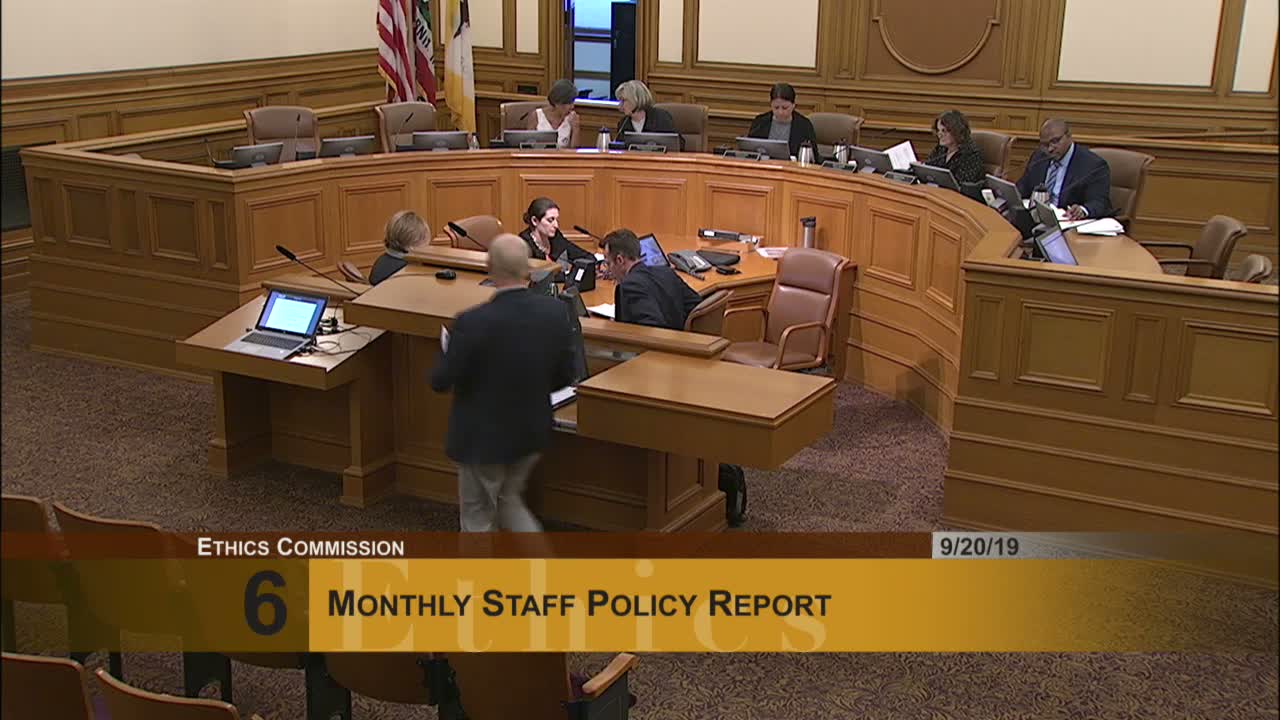
At the Sept. 1 meeting the Ethics Commission's policy staff updated commissioners on several policy items, including the city's public financing ordinance, an e‑filing project for Form 700, and a recent court decision with statewide implications.
Senior policy analyst Pat Ford said the Board of Supervisors had unanimously approved the public‑financing ordinance on first reading and that the second reading was scheduled for the coming Tuesday; if passed the ordinance would proceed to the mayor for signature and would have a 30‑day effective period with an operative date the commission had baked in as Jan. 1. Ford said staff are preparing operational materials so the commission can implement the ordinance for next year’s election cycle.
On Form 700 e‑filing, Ford said staff are still scoping operational details and bargaining‑unit engagement. The project aims to convert current paper filers to an electronic system by Jan. 1, 2021, and staff emphasized they will keep the e‑filing project and the biennial code review separate so code‑review debates about who must file do not hold up system implementation.
Ford also summarized an Aug. 26 ruling by the Third District Court of Appeal that struck down a 2016 legislative exemption that had allowed public financing in certain general‑law cities; he said the decision restores the pre‑2016 legal status for general‑law cities but does not affect San Francisco’s charter‑based public financing program. Ford said staff had confirmed that with the city attorney's office and included the case for context because the commission had weighed in on the 2016 legislation.
Commissioners asked about budget implications, timeline, and operational capacity; Ford said current appropriations (cited as roughly $2,800,000 annually) appeared sufficient under current participation estimates, but large increases in participation or a much higher volume of matched contributions could strain auditing resources.