Get Full Government Meeting Transcripts, Videos, & Alerts Forever!
Get email alerts on the Enforcement Prioritization topic
No spam. Unsubscribe anytime.
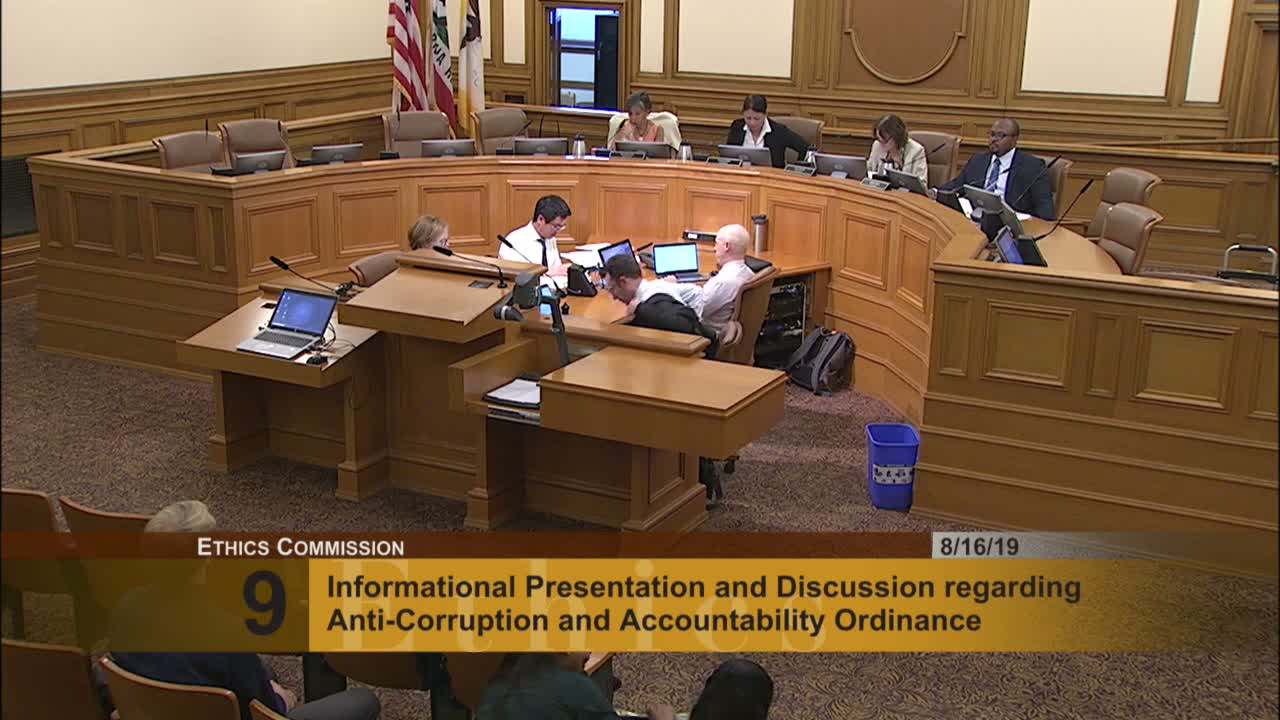
Enforcement director proposes triage framework as investigations backlog tops about 90 cases
Summary
The Ethics Commission’s enforcement director reported roughly 95 open investigations and proposed discretionary prioritization factors — severity, impact and probability of proof — and a hybrid approach to reduce the docket and free investigators, while commissioners asked for transparency and a public process to expand the fixed‑penalty policy.
San Francisco — The Ethics Commission’s enforcement team presented metrics showing a large investigative docket and proposed new intake and prioritization steps designed to concentrate resources on matters that most threaten public trust.
"For August that there are a full 95 investigations on this docket, for a staff of 3 investigators," the enforcement director reported, noting that approving the day’s proposed stipulations would reduce the open docket to about 90 matters.
Staff told commissioners it had seen behavioral changes after adopting a clearer distinction between formal and informal complaints and that the office had opened fewer matters this fiscal year than the previous election year. The enforcement director proposed a discretionary framework of factors — severity of the alleged violation, public impact, and the probability the division can substantiate the claim — to prioritize which meritorious complaints receive investigative resources.
Commissioners broadly supported a hybrid approach: swiftly clear matters that lack jurisdiction, apply triage to the existing docket so resources target the most serious and provable cases, and pursue expansion of the Commission’s fixed‑penalty program for predictable, low‑complexity violations.
Several commissioners emphasized that intent and the potential to undermine public trust should weigh heavily in prioritization. "If respondent commits a willful violation, it is a more severe violation," staff said, noting willful violations can carry criminal consequences beyond the Commission’s settlement jurisdiction.
The Commission asked staff to return with a proposal for a public engagement process to expand the fixed‑penalty policy, to consider warning letters, and to provide monthly summaries when staff dismisses or closes matters in the interest of justice, as required by the regulations. Commissioners also directed staff to follow up with the Bureau of Delinquent Revenue and to consider collections or referrals on long‑outstanding debts. The enforcement director agreed to return with a detailed framework at a future meeting.