Get Full Government Meeting Transcripts, Videos, & Alerts Forever!
Get email alerts on the Fixed Penalty Policy topic
No spam. Unsubscribe anytime.
Enforcement staff propose expanding fixed penalty policy; commission asks legal and process questions
Summary
Staff proposed a plan to broaden the commission’s fixed penalty policy to resolve low‑complexity violations via a schedule of penalties and warning letters; commissioners asked about regulatory grounding, charter limits and stakeholder engagement, and staff outlined a two‑stage interested‑persons process and a 6–12 month timeline.
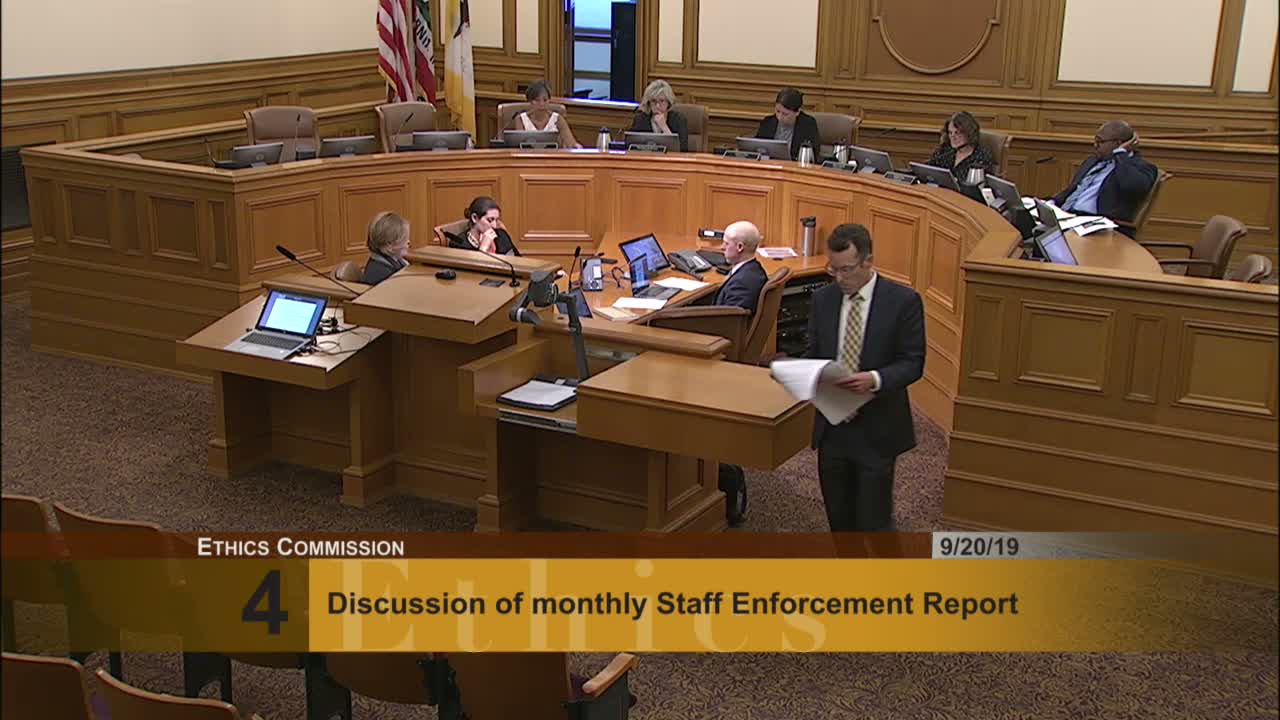
At the Ethics Commission’s Sept. 1 meeting staff presented a proposal to revise and expand the commission’s fixed penalty policy so the enforcement division could resolve certain low‑complexity matters more quickly through a schedule of penalties and defined mitigating and aggravating factors.
Staff described a two‑phase engagement: initial "interested persons" meetings to solicit broad input on the scope, followed by a second round presenting a drafted proposal for specific comments. The aim is to identify categories of violations suitable for streamlined resolution, recalibrate mitigating/aggravating factors, and consider procedural protections such as warning letters. Staff said they have begun benchmarking peer jurisdictions and consulting internal compliance teams.
Commissioners raised legal and structural questions. One commissioner asked whether the fixed penalty policy is part of the enforcement regulations; staff said it is not and exists independently as a policy. Commissioners also asked whether calibrating penalties below the maximum set by ordinance could be an improper delegation of authority or otherwise conflict with the Charter; staff acknowledged the concern and committed to consulting the city attorney and clarifying the policy’s regulatory or ordinance footing before finalizing recommendations.
Staff tentatively scheduled the first round of interested‑persons meetings for November (between the election and Thanksgiving) and estimated a full process could take from six months to a year depending on controversy and iteration. Commissioners suggested making interim drafts available to the commission and recommended at least one community meeting outside the office to broaden participation.
Staff will report back with benchmarking results, draft language for discussion, and any legal memoranda on authority and Charter alignment before bringing a formal revision to the commission for possible action.