Get Full Government Meeting Transcripts, Videos, & Alerts Forever!
Get email alerts on the Enforcement Operations topic
No spam. Unsubscribe anytime.
Ethics staff report on secondary employment, investigations and collections; ACAO forms go live amid strong public criticism
Summary
Staff reported fewer preliminary-review matters (about 45), more investigations (93), and discussed secondary-employment disclosures, warning letters and collection efforts; Executive Director Pelham said ACAO reporting forms are now live. Several public commenters accused the Commission of failing to act on alleged corruption and voting fraud.
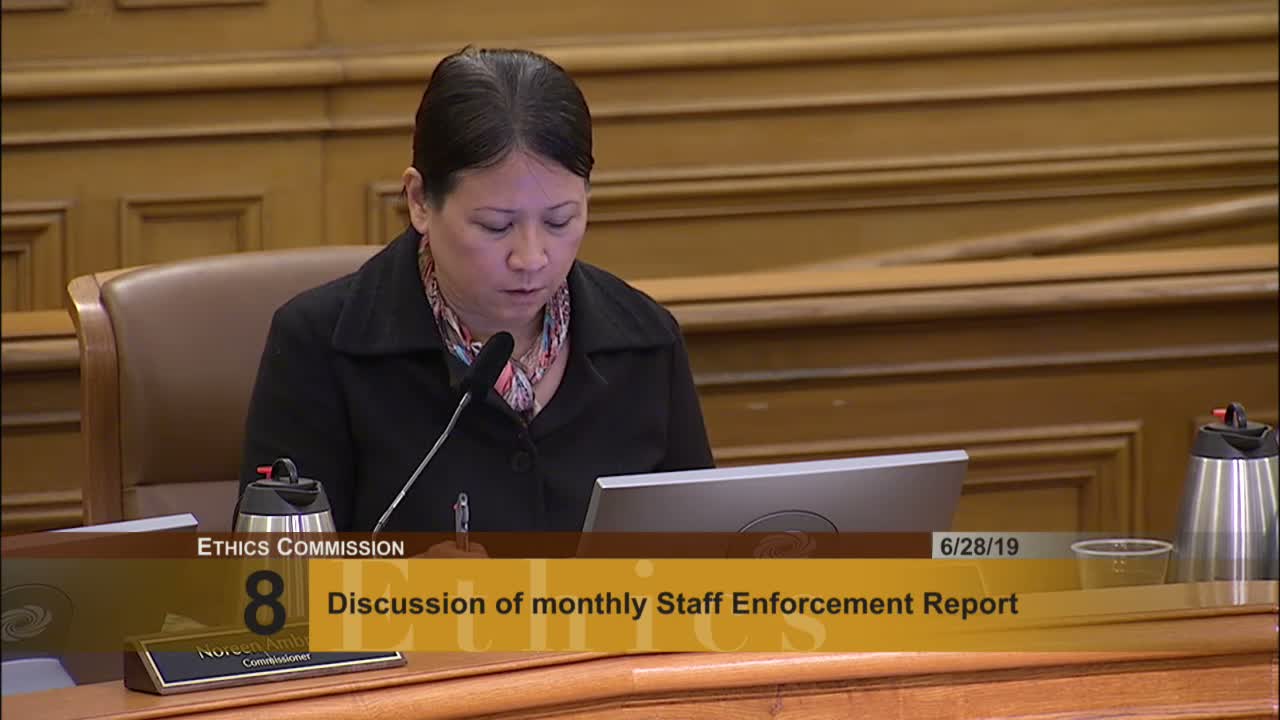
The Ethics Commission heard an operational enforcement report that covered secondary employment, caseload metrics, use of warning letters, fines collection and jurisdictional limits on collections; Executive Director Pelham separately announced that reporting forms required by the Anti-Corruption and Accountability Ordinance are now live online.
Enforcement staff said they attended a Department of Human Resources consultants meeting focused on secondary employment and confirmed city employees must disclose outside income and seek departmental permission when required. "Under the civil service rules, they have to disclose the existence of that secondary employment," staff said, adding that the process can trigger additional Form 700 disclosures when officers are required to file statements of economic interest.
Staff provided caseload figures: preliminary-review matters had fallen to about 45 (from 57 a month earlier), while matters under investigation rose to about 93. Staff said it typically takes about three months to open an investigation, roughly nine months to reach dismissal in some matters, and that matters under investigation are averaging about 14.5 months in the division's pipeline.
On warning letters, staff noted the division already issues them but cautioned that making those letters public might run afoul of charter confidentiality rules that protect investigative documents prior to a probable-cause finding. "I would add that we we do in fact issue warning letters...the public wouldn't be aware of those because we don't publicize them in the same way that we do stipulations," staff said.
Staff also described enforcement collection work: a fines collection officer has audited the late-fee program and collected about $7,000 in previously unpaid fees. The Bureau of Delinquent Revenue handles certain collections; staff said cases involving out-of-state debtors — for example, individuals who reside in New York — were referred to outside collection agencies because local jurisdictional options are limited.
During two public-comment periods several speakers sharply criticized the Commission's enforcement and accountability work. Public commenter Ellen Lijao, a bargaining-team member for SEIU, told the Commission she has filed complaints and urged it to "restore law and order" and to act on management misconduct. Another commenter, who identified herself as Ellen Lee Zhao, alleged widespread corruption and voting fraud in San Francisco and urged the Commission to investigate those claims.
Executive Director Pelham said ACAO forms are live and staff have prepared guidance and materials to support filers. "As of this week all forms are now live and available for people to use for filing," he said, and staff will schedule a demonstration for commissioners and interested members of the public.
The Commission directed staff to follow up on questions about warning letters with the city attorney's office, to seek clarity about bureau collection options, and to present additional detail at a future meeting.