Get Full Government Meeting Transcripts, Videos, & Alerts Forever!
Get email alerts on the Outside Employment Enforcement topic
No spam. Unsubscribe anytime.
Ethics Commission hears DHR on outside employment; staff report shows enforcement docket work
Summary
Department of Human Resources staff briefed the Ethics Commission on the city’s secondary (outside) employment review process, citing an uptick from the gig economy and describing how departments, DHR and the city attorney coordinate reviews, notices and potential disciplinary steps. Staff also reported enforcement docket counts and planned workflow changes.
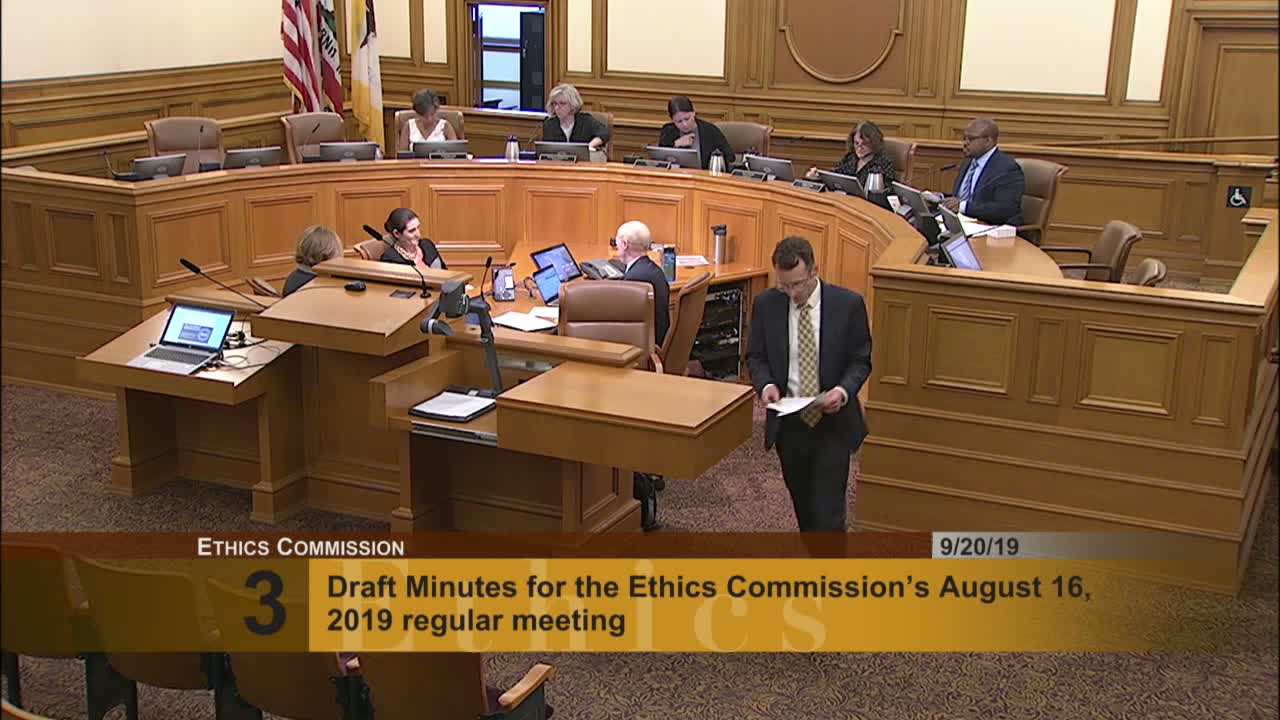
The San Francisco Ethics Commission on Sept. 1 heard a briefing from the Department of Human Resources on the city’s additional‑employment process and an update from enforcement staff on the division’s caseload.
DHR client‑services consulting manager Sean Sherburne told commissioners the department requires any city employee receiving compensation, emoluments or other benefit from outside work to submit an additional employment request and, where appropriate, obtain an advance written determination. "We have seen an uptick with the gig economy," Sherburne said, citing Uber, Lyft and short‑term rental examples, and added that the form is being updated "in consultation with the ethics commission and the city attorney's office." He said onboarding and annual reminders are being used to improve compliance.
Sherburne and deputy director Anna Biasbos described the factors DHR reviews: whether outside work interferes with scheduled city duties or public‑safety shifts; whether it creates an incompatibility with an employee's city responsibilities (for example, procurement or contracting); and whether the outside work risks harm to the city's reputation. Sherburne said higher compensation for consultative work prompts deeper review of services, clients and hours, and that departments are advised to secure an advanced written determination for higher‑level employees.
On enforcement, staff said the commission’s docket includes matters in preliminary review and investigation. The enforcement division reported roughly one‑third of matters in preliminary review and about two‑thirds under investigation, with 47 matters awaiting a jurisdictional/attention decision and 91 matters currently under investigation. Staff said they plan a mini retreat to apply discretionary factors to existing investigations and to consider expanding the fixed penalty policy to accelerate resolution of low‑complexity matters.
Commissioners pressed staff on appeals and notice procedures. Sherburne said denial notices typically flow through a department’s HR team and appointing officer, often in letter form with reasons and possible discipline if the employee persists in disallowed outside work. He said decisions of the human resources director can generally be appealed to the civil service commission, though he had not encountered an appeal in this process. A commissioner later noted civil service rule 105.120.4 (for "other matters") can allow a 30‑day calendar‑day appeal, which the panel clarified in discussion.
Chair Chu thanked DHR for the briefing and asked staff to coordinate further with the commission and the city attorney’s office on edge cases, guidance for departments, and outreach to employees.