Get Full Government Meeting Transcripts, Videos, & Alerts Forever!
Get email alerts on the Public Financing topic
No spam. Unsubscribe anytime.
Ethics Commission approves Phase 2 public-finance reforms, sending package to Board of Supervisors
Summary
The San Francisco Ethics Commission voted unanimously to approve a Phase 2 package of public financing changes — including a 6:1 match on small donations (staff recommended matchability up to $100; the Commission adopted $150), higher initial grants and larger spending limits — and will transmit the ordinance to the Board of Supervisors with an operative date of Jan. 1, 2020.
The San Francisco Ethics Commission on a 4–0 vote approved a set of Phase 2 legislative recommendations to expand and recalibrate the city’s small-donor public financing program, directing staff to transmit the ordinance to the Board of Supervisors with an operative date of Jan. 1, 2020.
Pat Ford, the Commission’s policy lead, told commissioners the package aims to strengthen small-donor incentives while keeping the program financially feasible. Staff proposed matching small contributions at a 6-to-1 rate and researched three matchable caps; the staff recommendation examined a $100 cap, and an alternative $150 cap was also analyzed. "This proposal is to extend the $100 limit across the whole program, so that candidates would only ever be able to have up to $100 of a contribution matched," Ford said during his presentation; he also explained that a $150 cap was likely to attract broader consensus while still preserving the policy goal of rewarding smaller donations.
The package approved by commissioners includes: a 6-to-1 match for small donations with staff analysis centered on $100 but the Commission adopting a compromise at $150; increased initial grants of $60,000 for supervisorial candidates and $300,000 for mayoral candidates; higher maximum public-financing awards (for supervisorial candidates, the staff recommended a middle figure and preserved a small incumbent/nonincumbent differential); and higher candidate spending ceilings ($350,000 for supervisorial candidates and $1.7 million for mayoral candidates). The Commission also voted to retain the current initial-grant distribution timing (the 142‑day date under current law) rather than moving to the earlier 284‑day distribution staff had floated.
Deputy City Attorney Shen cautioned that an ordinance cannot bind the Board of Supervisors to make appropriations, explaining that "the budgeting and appropriation process in the city is set forth in the city charter," and that the charter confines binding appropriation authority to the Board. Ford said staff had sought harmonized appropriation language but omitted it on legal advice and will work with the Board and Mayor on any supplemental requests.
Support and opposition surfaced in a lengthy public comment period. Advocates and organizations including Common Cause, the ACLU Foundation of Northern California, FairVote California and numerous small-donor advocates urged larger grants, higher match ratios and earlier disbursements to help grassroots candidates. Several commenters supported the package’s core features but urged caution on changing the early-disbursement date; one public commenter said past early distributions had produced many low-performing candidates. Another speaker expressed strong opposition to public financing on political grounds.
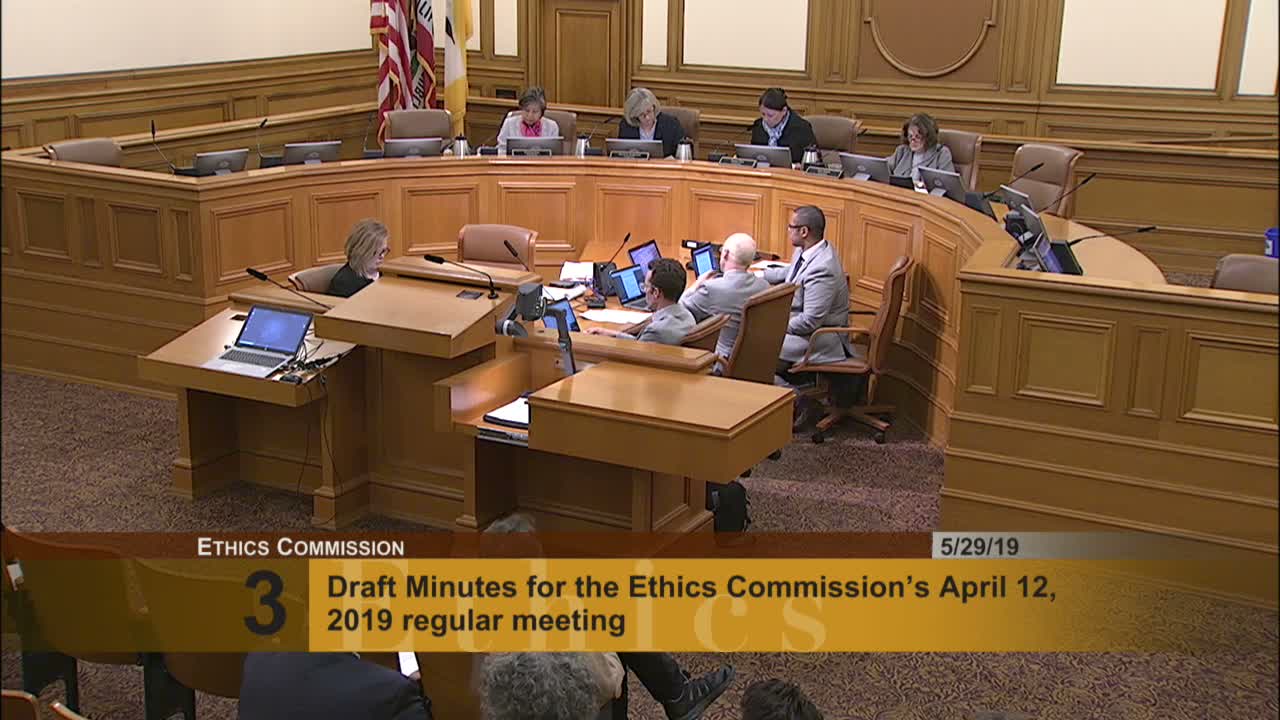
Chair Chiu moved the amended package and, after a brief procedural clarification and a recorded roll call, the amended motion carried unanimously. Director Pelham conducted the roll call: Commissioners Smith, Lee, Ambrose and Chair Chiu voted aye. The Commission directed staff to prepare the ordinance for transmittal to the Board of Supervisors and to continue outreach and monitoring of fund levels and implementation timing.
The Board will consider the ordinance through the regular legislative process; staff said the measure will require sponsor support and coalition building to advance to the Board and noted the package’s recommended operative date of Jan. 1, 2020.
The Commission asked staff to reconcile methodological differences with the Board’s Budget and Legislative Analyst before transmittal and to continue monitoring participation rates and fund balances as implementation proceeds.