Get Full Government Meeting Transcripts, Videos, & Alerts Forever!
Get email alerts on the Public Financing topic
No spam. Unsubscribe anytime.
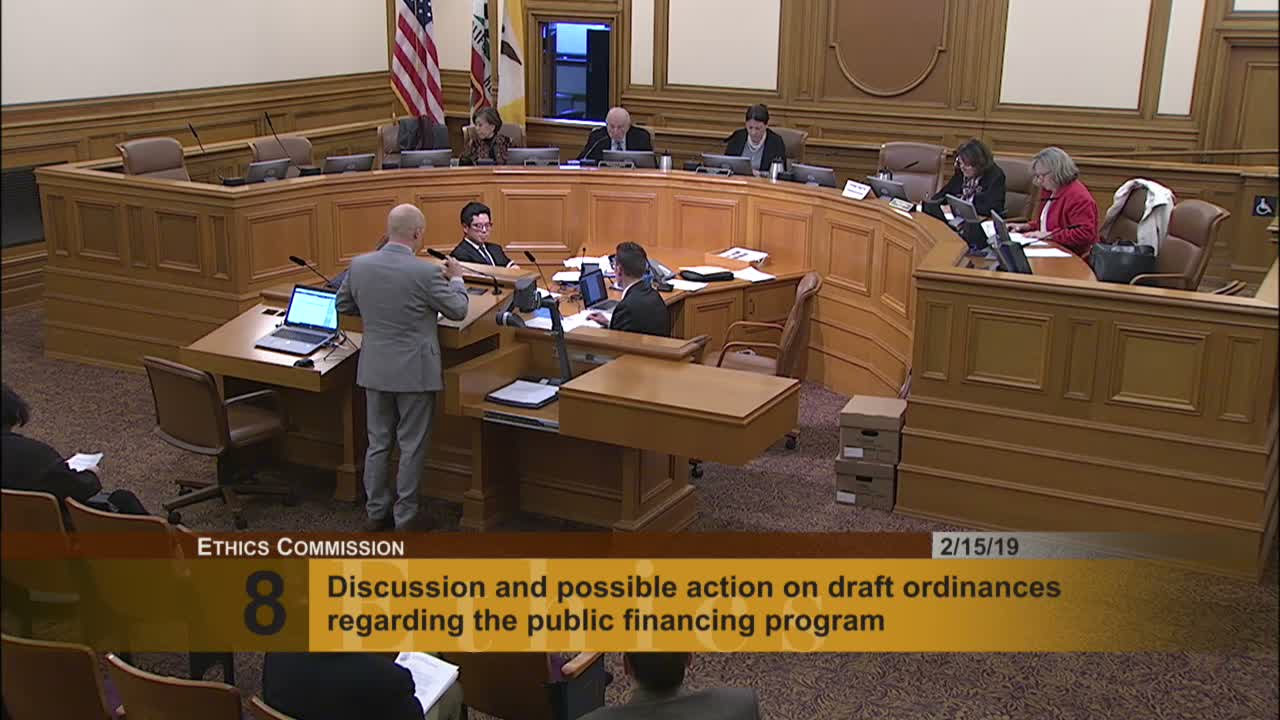
Ethics Commission approves changes to public financing rules, directs staff to draft ordinance
Summary
The San Francisco Ethics Commission voted to change the public financing program—s timeline and how candidates— spending ceilings adjust: the commission moved the notice-of-intent deadline to three days after candidate filing, set new incremental increases ($50,000 for supervisor races, $250,000 for mayoral races), changed the trigger to activate as soon as opponent activity exceeds a candidate—s ceiling, and eliminated the contingency account; staff will draft a consolidated ordinance for the Board of Supervisors.
The San Francisco Ethics Commission on Feb. 1 voted to alter several procedural components of the city—s public financing program and directed staff to consolidate the approved changes into a single ordinance for transmittal to the Board of Supervisors.
The commission approved four separate actions by roll call: (1) move the notice-of-intent-to-participate filing deadline to three days after the candidate filing deadline; (2) increase the minimum incremental adjustments to individual expenditure ceilings (IECs) to $50,000 for supervisorial races and $250,000 for mayoral races; (3) change the trigger so an IEC adjustment occurs as soon as the formula measuring opponent activity exceeds a candidate—s current limit by any amount (instead of waiting for a full increment); and (4) eliminate the program—s contingency account. The measures passed by votes of 5—0 (first three actions) and 4—1 (contingency account elimination; Commissioner Copp dissented).
Pat Ford, the commission—s policy analyst, said the package emerged from a phased review of the public financing program that began the previous summer. Ford described three staff-drafted ordinance alternatives: Attachment 1 would release a candidate from the spending limit once opponent activity surpassed the candidate—s ceiling; Attachment 2 would keep the incremental adjustment model but increase the minimum increment sizes; Attachment 3 would retain the status quo. "The project initially was in response to a series of appeals, concerns, [and] a high volume of questions that were coming in from candidates," Ford told the commission, describing staff—s aim to reduce compliance burdens without changing the program—s basic structure.
Commissioners and public speakers debated trade-offs. Supporters of a larger increment said bigger steps would reduce rapid, repetitive adjustments during a compressed election period and give publicly financed candidates more predictable "headroom" to respond when outside money flows into a race. Opponents warned that very large increments or a full release could hand additional advantages to well-funded campaigns or special-interest independent expenditure committees.
John Golinger, a public-interest lawyer and longtime campaign finance advocate, urged a middle path. "$50,000 instead of $10,000 is a five-times improvement on the current system," he said, while cautioning against eliminating limits entirely. Shannon Geist of the California Clean Money Campaign said Attachment 1 (a full release) "would kill the ceiling in most competitive races," citing Los Angeles— experience.
Several campaign managers and supervisors— aides urged the commission to preserve the existing method of calculating "supportive funds" based on contributions rather than expenditures, citing disclosure timing and campaign operations. Edward Wright, legislative aide for Supervisor Gordon Maher, said his office had prepared alternative proposals and would work with commission staff in drafting final language.
After public comment and extended commissioner discussion of the options and empirical modeling, Chair Chiu moved the set of changes that the commission approved. Commissioners said staff should prepare a new ordinance incorporating the specific actions the commission supported and transmit it to the Board of Supervisors for consideration. Deputy City Attorney Shen reminded the commission that amendments to this portion of the campaign and governmental conduct code require a four-fifths vote of the commission to forward.
The immediate effects approved at the meeting are procedural: changing the notice-of-intent deadline (timing), increasing the increment amounts for IEC adjustments, changing the trigger to act upon any excess opponent activity, and removing the contingency account. The commission did not adopt the option to change the calculation of supportive funds from contributions to expenditures.
Next steps: staff will draft ordinance text that reflects the approved provisions and return the ordinance to the commission—s packet and transmit it to the Board of Supervisors as directed.
Vote tallies and procedural notes: the notice-of-intent deadline change and IEC increment changes passed by roll call 5—0; the "any-amount" trigger change passed 5—0; elimination of the contingency account passed 4—1 with Commissioner Copp recorded in dissent. The commission instructed staff to prepare a consolidated ordinance for the Board of Supervisors and asked staff to include supporting analysis showing projected operational effects of the chosen increment sizes.