Get Full Government Meeting Transcripts, Videos, & Alerts Forever!
Get email alerts on the Public Financing topic
No spam. Unsubscribe anytime.
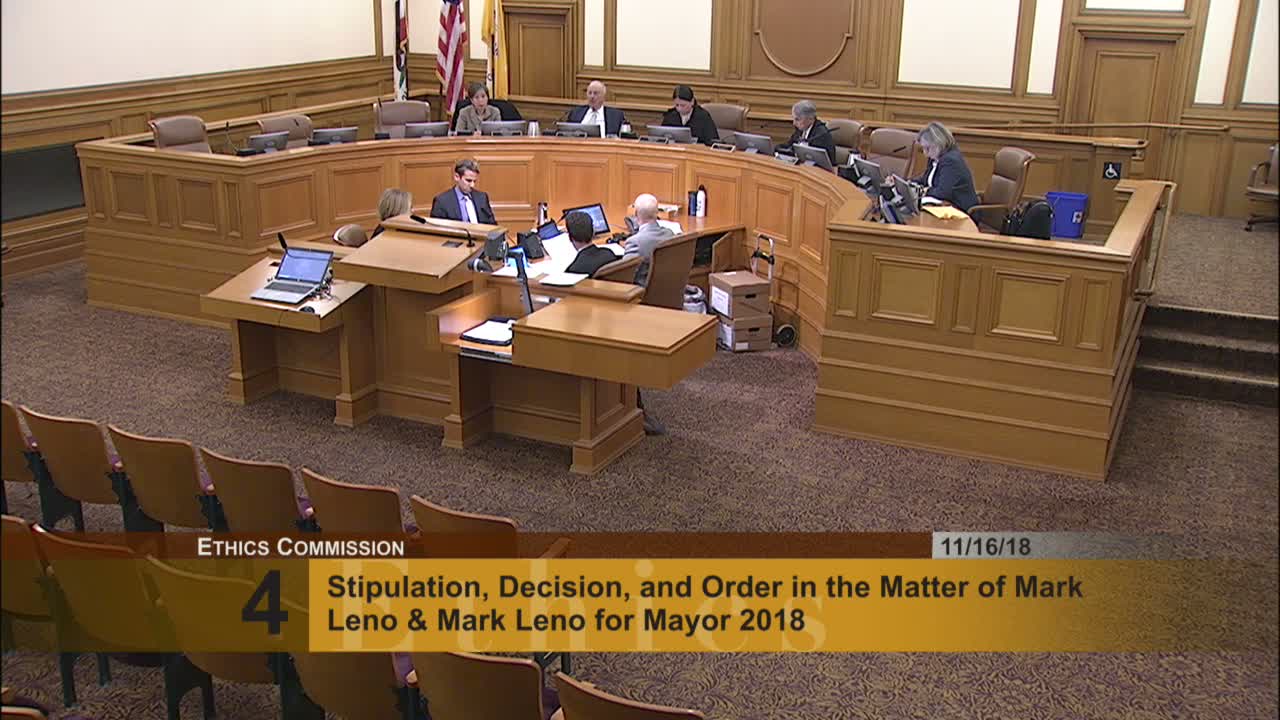
Ethics Commission adopts clearer public-financing regulations and a revised appeals standard, defers penalty ordinance
Summary
The San Francisco Ethics Commission approved regulatory changes to the public-financing program that clarify the appeals process — adopting a bifurcated standard of review — and postponed a proposed penalty ordinance to the December meeting for legal review.
The San Francisco Ethics Commission on its regularly scheduled meeting approved revisions to the public-financing regulations that clarify how the commission will review appeals from candidates, and deferred consideration of a separate penalty ordinance for further legal study.
Pat Ford, the commission's senior policy analyst, presented a package of recommendations that included Attachment 1 (regulations) and two separate ordinance proposals. Ford said the draft regulations would create an explicit standard of review for appeals and highlighted an alternative, bifurcated standard: "for questions of law, no deference would be given to staff determinations" while "for questions of fact, they would be reviewed under basically a clearly erroneous standard," giving "less deference to staff determinations." (Pat Ford)
Commissioners debated whether to bundle the staff-recommended regulatory changes with a separate penalty ordinance reportedly proposed by Supervisor Safa's office. Several commissioners and staff warned that the penalty proposal — which could bar certain individuals from receiving public financing — raised questions about retroactivity and whether imposing a monetary penalty plus a bar on future participation might amount to a double penalty. Deputy City Attorney John Giffner told the commission that constitutional issues often arise in campaign finance proposals and recommended a closed session if the commission wanted privileged legal advice.
After discussion, commissioners moved to amend Attachment 1 to adopt the bifurcated appeals standard. Commissioner Ambrose said the revision better reflected the commission's role on legal questions and on correcting factual errors on appeal: "on questions of law the commission sits de novo and exercises its own judgment on what the law requires. And on questions of fact we would defer to the staff's careful review... if on appeal somebody shows that there was clearly an error, we would have the opportunity to correct that and move forward." (Commissioner Ambrose)
The amendment passed and the commission voted to approve Attachment 1 as amended. The motion carried 3 to 2.
The commission also decided to continue Attachments 2 and 3 (the larger public-financing ordinance and the proposed penalty ordinance) to its December meeting and to schedule a closed session on constitutional and litigation risks before taking further action.
Staff said the adopted regulatory clarifications are intended to give candidates and staff clearer guidance about appeals and to allow the office to update candidate guides and trainings ahead of the next election cycle. The next procedural step is a legal briefing in closed session at the December meeting, after which the commission may revise or forward ordinances to the Board of Supervisors.