Get Full Government Meeting Transcripts, Videos, & Alerts Forever!
Get email alerts on the Public Financing topic
No spam. Unsubscribe anytime.
Ethics Commission defers vote on public-financing ordinance after hours of testimony
Summary
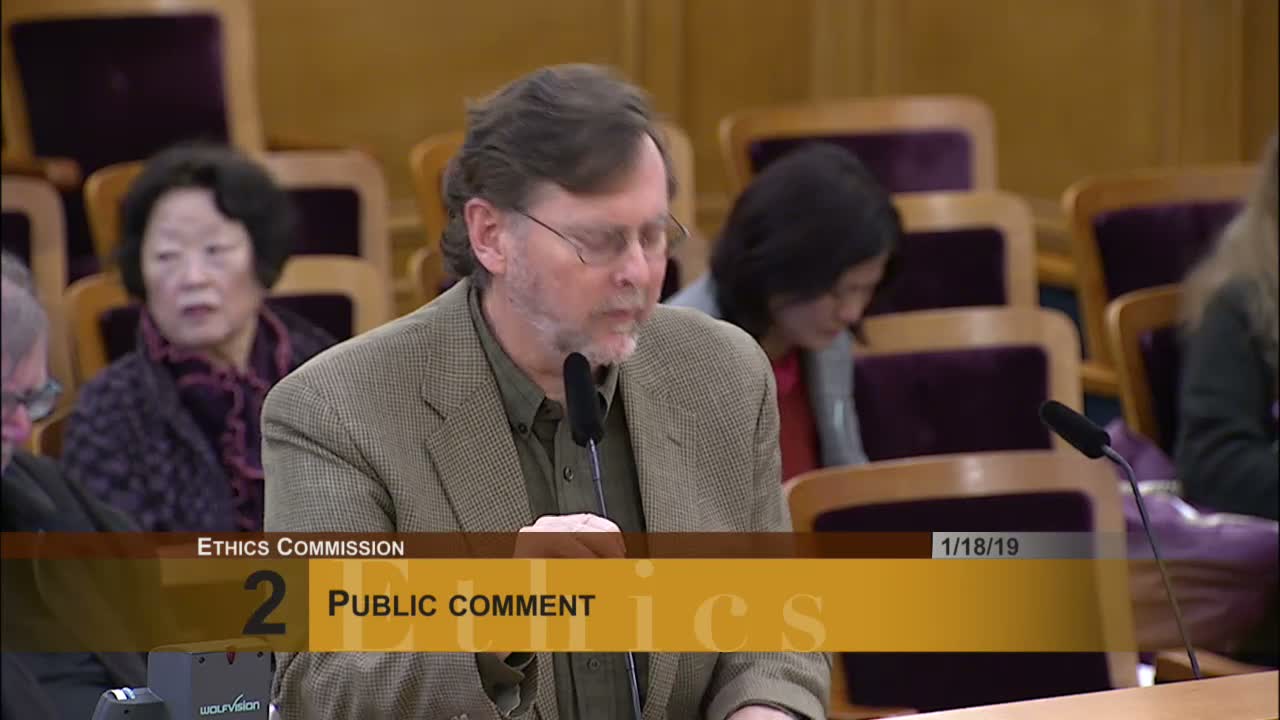
After hours of public comment from reform advocates, candidates and community groups, the San Francisco Ethics Commission voted to take testimony on proposed changes to the public-financing rules but defer formal action to the February meeting to allow additional analysis and a commissioner's participation.
The San Francisco Ethics Commission heard extended public comment on proposed draft ordinances to the city's public-financing program and voted to take testimony at the January meeting but postpone any formal vote until February.
Advocates and former candidates told commissioners the staff proposal to effectively lift expenditure ceilings when triggers are met would weaken the program. "It's like using a meat cleaver instead of a scalpel," said Steven Hill, a co-author of Proposition O who urged the commission to pursue narrower changes. Hill and other speakers cautioned that lifting limits once certain thresholds are reached could accelerate outside spending and undermine the public dollars intended to boost small-donor participation.
John Gollinger, a longtime campaign-finance reform advocate, pointed to comparative data and urged alternatives. "Rather than simply do away with spending limits, change the increment," he said, suggesting a larger increment so limits are not raised as frequently. Catherine Ashworth of the California Clean Money Campaign also warned against importing Los Angeles's approach to completely lifting caps and urged a package of changes that preserves transparency and small-donor incentives.
Commissioners asked staff for additional research and comparative charts showing how other jurisdictions treat triggers and incremental adjustments. The commission adopted a motion to receive public comment now but defer formal action on the ordinance until the February meeting so absent Commissioner Lee could participate; the motion carried unanimously.
Supporters of the existing structure urged several alternatives that staff and commissioners asked to see in the February packet: increasing the increment used to raise caps (speakers proposed $50,000 instead of $10,000 in some races), considering whether triggers should be based on contributions or expenditures, and raising public-match ratios so participating candidates have more resources while retaining expenditure constraints. Speakers also asked staff to include all written public comments in the next packet.
The commission directed staff to present a charted comparison of jurisdictions that use expenditures, contributions or the greater of either as the trigger; to outline jurisdictions that use a stepwise increment versus those that lift caps outright; and to propose alternative amendment language that would reduce administrative burden while preserving the program's objectives. The item will return for possible action at the February meeting.