Get Full Government Meeting Transcripts, Videos, & Alerts Forever!
Get email alerts on the Anti Corruption Ordinance topic
No spam. Unsubscribe anytime.
Ethics Commission forwards Anti‑Corruption and Accountability Ordinance to Board after split votes on substantive amendments
Summary
The commission approved the Board-amended Anti‑Corruption and Accountability Ordinance (Board file 180,280) with staff technical recommendations and a technical clarification, but rejected two substantive amendments — a behested‑payments ban and a 25% private recovery provision — after public testimony from nonprofits and legal counsel.
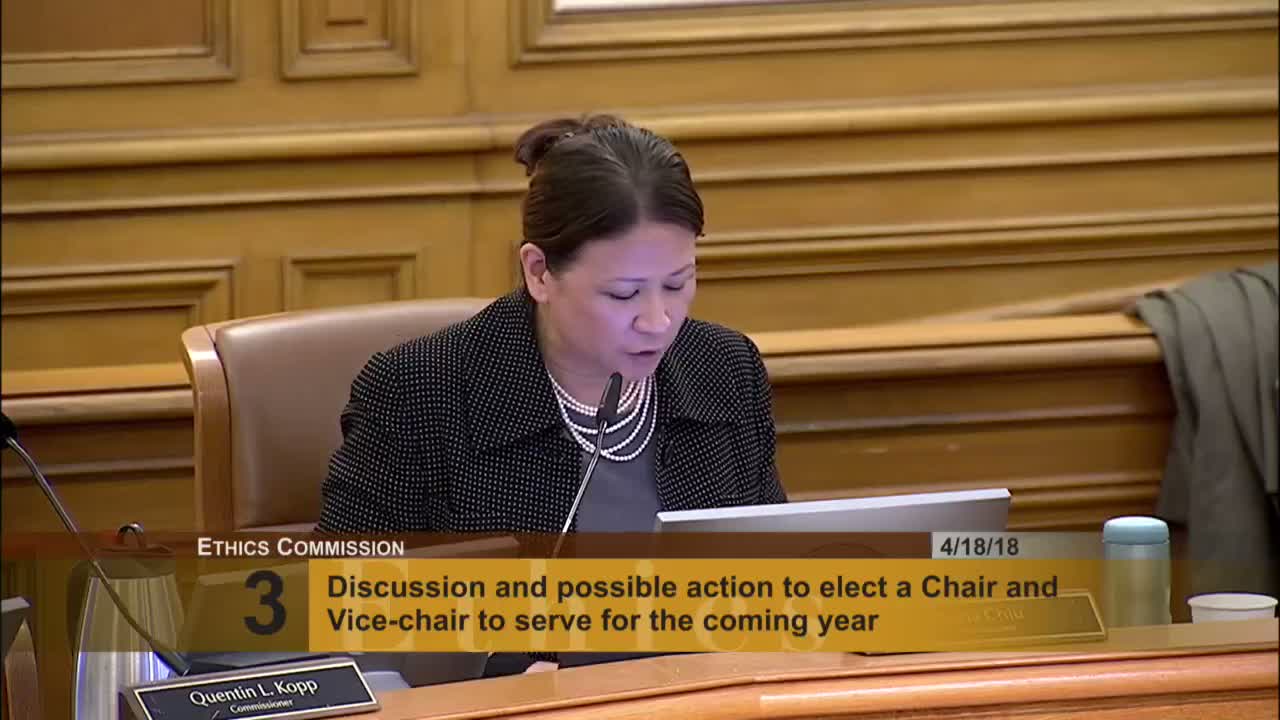
The San Francisco Ethics Commission voted April 18, 2018, to adopt and forward to the Board of Supervisors an amended Anti‑Corruption and Accountability Ordinance (Board file 180,280) after a lengthy public‑comment period and several floor amendments.
The commission first approved a motion to adopt the ordinance as amended by the Board on April 3 together with staff’s recommended technical changes. That motion passed on a 4–1 roll‑call vote: Commissioners Chiu, Lee, Rennie and Ryan voted aye; Commissioner Quentin Kopp voted no. The commission also approved a separate technical amendment clarifying that disclosure must include the "office and name" of a city elective officer; that amendment passed unanimously.
Commissioner Kopp proposed two substantive changes that failed. His motion to restore a prohibition on "behested payments" (language that would bar a city elective officer from soliciting payments to third parties in certain circumstances) was defeated on a 4–1 vote. Kopp argued disclosure alone would be "toothless" and cited high levels of nonprofit contracting; other commissioners and counsel warned restoring the ban could imperil passage at the Board of Supervisors.
Kopp’s second motion would have added a private right of action in section 1.17 to award a resident 25 percent of recovered penalties in a successful suit; that amendment also failed on a 4–1 vote. Staff and the city attorney said the proposal was not part of the Board’s adopted language and represented a new substantive change to be considered by the Board if the commission wished.
Public testimony reflected divided views. Charlie Marsteller (Friends of Ethics) called the ordinance weaker than prior ballot measures; several nonprofit representatives, including Debbie Lerman (San Francisco Human Services Network), Peter Cohen (community housing organizations) and Jan Masoka (California Association of Nonprofits), urged the commission to forward the Board‑amended package with staff recommendations, saying the package balanced reform with practical concerns for nonprofit service providers. Legal counsel from Pillsbury Winthrop raised technical issues about contractor contribution prohibitions and the scope and timing of certain reporting requirements.
Staff described several non‑substantive, technical edits and recommended removing the defined term "electronic media technologies" in favor of broader language requiring reporting of electronically distributed communications (to capture email and text messages) and urged mirroring those changes across related sections (1.162 and 1.163). Staff also suggested adding a reference to January 1, 2019, as an operative date for some provisions; the commission discussed but did not make additional substantive changes that would reopen negotiations at the Board.
The final motion to adopt the ordinance as amended and forward it to the Board passed by the supermajority required to send the ordinance back for final action. The commission instructed staff to proceed with implementation steps and noted that regulatory definitions (for example, the definition of "promptly") would be developed after the ordinance becomes law, recognizing scheduling constraints under the commission's rule‑making timeline.
Votes at a glance:
- Adopt ordinance as amended by the Board with staff recommendations — Passed, 4–1 (Chiu, Lee, Rennie, Ryan aye; Kopp no). - Clarify language to require disclosure of "office and name" — Passed, 5–0. - Reinstate behested payments ban (Kopp amendment) — Failed, 1–4. - Add private right of action awarding residents 25% recovery (Kopp amendment) — Failed, 1–4.
Next steps: The ordinance will be returned to the Board of Supervisors for final action; commissioners and staff indicated regulatory rule‑making and monitoring will follow if the Board and mayor enact the ordinance.