Get Full Government Meeting Transcripts, Videos, & Alerts Forever!
Get email alerts on the Campaign Finance Reform topic
No spam. Unsubscribe anytime.
Ethics Commission amps up anti‑corruption draft but stops short of June ballot; seeks joint talks with Board of Supervisors
Summary
After six hours of testimony and line‑by‑line debate, the Ethics Commission adopted a package of staff and commissioner amendments to its anti‑corruption ordinance but declined to submit the full measure to the June 5 ballot, voting instead to transmit the amended package to the Board of Supervisors and seek a joint meeting to reconcile remaining items, including Supervisor Peskin’s major‑donor disclosures.
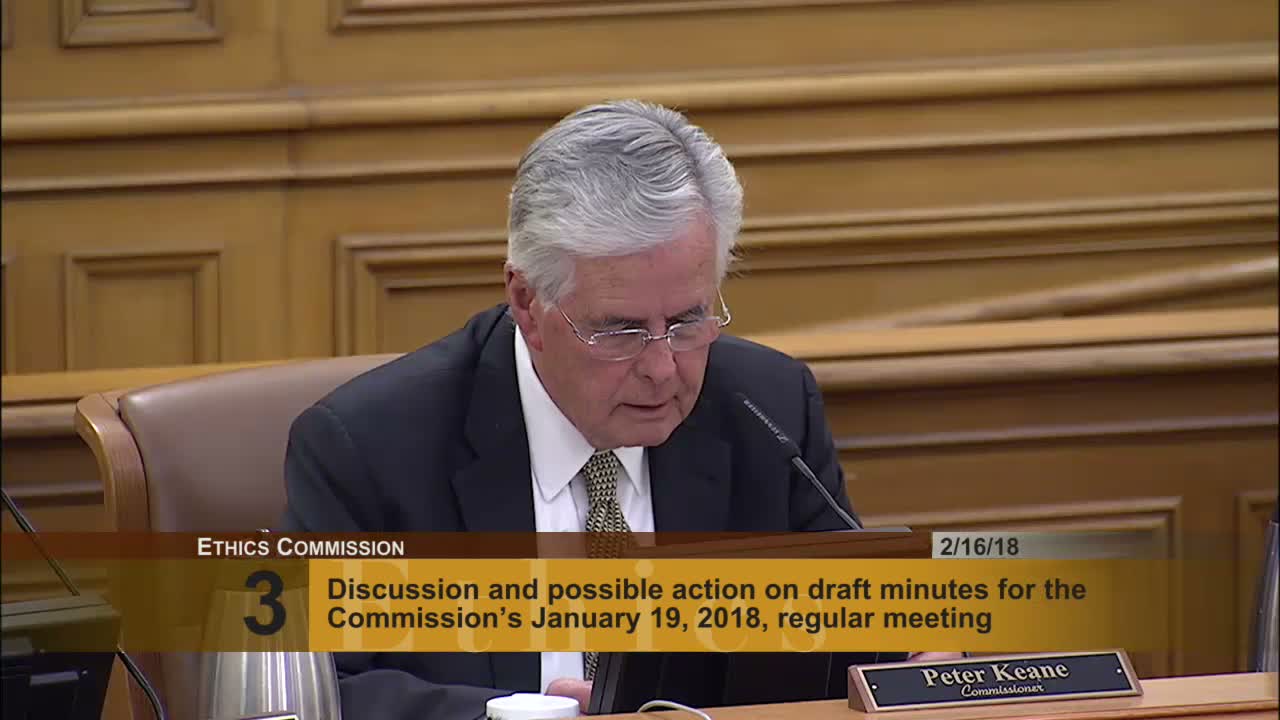
The San Francisco Ethics Commission on Feb. 16 adopted a bundle of staff‑recommended changes to its long‑debated Anti‑Corruption and Accountability Ordinance but stopped short of putting the measure before voters in June.
Pat Ford, the commission’s policy analyst, told commissioners the package before them combined the ethics commission’s November draft with staff amendments and a recently introduced proposal on major‑donor financial disclosures from Supervisor Aaron Peskin’s office. Ford said staff recommended adopting the amended text and placing it on the June ballot to give voters a say and to spur action at City Hall.
The meeting devolved into sustained, often contentious discussion over a handful of provisions that commissioners and members of the public said could either strengthen enforcement or, if written too broadly, chill ordinary civic activity. Key changes that the commission adopted included: making a contributor attestation card voluntary rather than compulsory for donations of $100 or more (1.114.5); narrowing bundler disclosures to a financial record rather than inquiries into whether a bundler “attempted to influence” an official (1.125); removing a contested land‑use restriction (1.127) from the ballot package so staff can rework it with planning officials; and refining behested‑payment disclosures so they apply only where the payor has a financial interest in the matter being influenced.
Public testimony was heavy and sharply divided. Ellen Lee Zhao, who identified herself as a 11‑year behavioral health clinician and SEIU bargaining team member, opened public comment with a plea for investigations of alleged retaliation and missing records. “Please investigate the complaints that we filed with the Ethics Commission,” she said. Ray Hartz of San Francisco Open Government and others urged stronger enforcement language and questioned staff responsiveness. Lee Hepner, representing Supervisor Peskin, urged a joint session of the Board of Supervisors and the Ethics Commission and asked the commission not to delay the major‑donor disclosures; Hepner said some reforms could and should be implemented before November.
A focal point of debate was the ordinance’s conflict‑of‑interest language, especially the phrase “anything of value.” Commissioners worried the term was broad enough to cover routine nonprofit activity (for example, arranging a water station at a charity walk) and could deter experienced nonprofit leaders from serving on boards. Commissioner Lee urged narrowing or deleting the provision as it relates to organizations; staff and others replied that the draft tracks a standard “reasonably expected to influence” test and that protections should prevent self‑dealing where officials have a direct role in an organization’s governance or finances.
Commissioners also wrestled with a proposed recusal‑review process (3.209) modeled on Los Angeles law that would trigger a staff review when a commissioner files multiple recusals in a 365‑day window. After public concern that such a rule could disincentivize lawful recusals by nonprofit representatives, the commission retained the recusal‑review language but added a provision that would allow a recommended divestiture or removal only after the commission’s determination and with a 90‑day (or as‑practicable) window to remedy conflicts.
The most consequential procedural decision arrived late: whether to submit the amended package to the June 5, 2018 ballot. Commissioners split after hours of argument and public comment; concerns about implementation timelines, the need for additional regulatory and technological work (for filing and online disclosure systems), and the desire for closer coordination with the Board of Supervisors led the commission to reject the motion to place the measure on the June ballot.
Instead, commissioners voted to transmit the Ethics Commission’s amended ordinance to the Board of Supervisors and to request a prompt joint meeting so both bodies can work to reconcile the ethics commission’s changes with Supervisor Peskin’s major‑donor proposal. Lee Hepner said Supervisor Peskin’s office favors a joint session to accelerate enactment and to make certain major‑donor disclosures effective before key elections. Several oversight and good‑government groups urged patience and broader interagency work; others urged the commission to press forward in order to restore reforms voters had adopted in earlier ballot measures.
What’s next: the commission will seek a joint session with the Board of Supervisors to negotiate remaining language, and staff will continue to refine drafting and implementation plans — especially rules that rely on new filing systems and online disclosures. The measure as amended by the Ethics Commission is not on the June ballot and will require more inter‑branch agreement, or a separate vote, before becoming law.