Get Full Government Meeting Transcripts, Videos, & Alerts Forever!
Get email alerts on the Campaigns And Corruption topic
No spam. Unsubscribe anytime.
Ethics Commission narrows anti‑corruption proposal, opts for stepped disclosure instead of ban on behested donations
Summary
After hours of debate, the San Francisco Ethics Commission directed staff to replace a proposed ban on behested (third‑party) payments with an enhanced disclosure regime, trimmed a private‑plaintiff civil‑penalty award from the draft, and approved a package of other changes to the anti‑corruption and accountability ordinance by a 4–1 vote.
The San Francisco Ethics Commission on Oct. 23 gave staff policy direction to substantially revise the city—s proposed anti‑corruption and accountability ordinances, including replacing a proposed prohibition on behested (third‑party) payments with a stepped‑up disclosure regime and removing an automatic 50 percent civil‑penalty award for private plaintiffs.
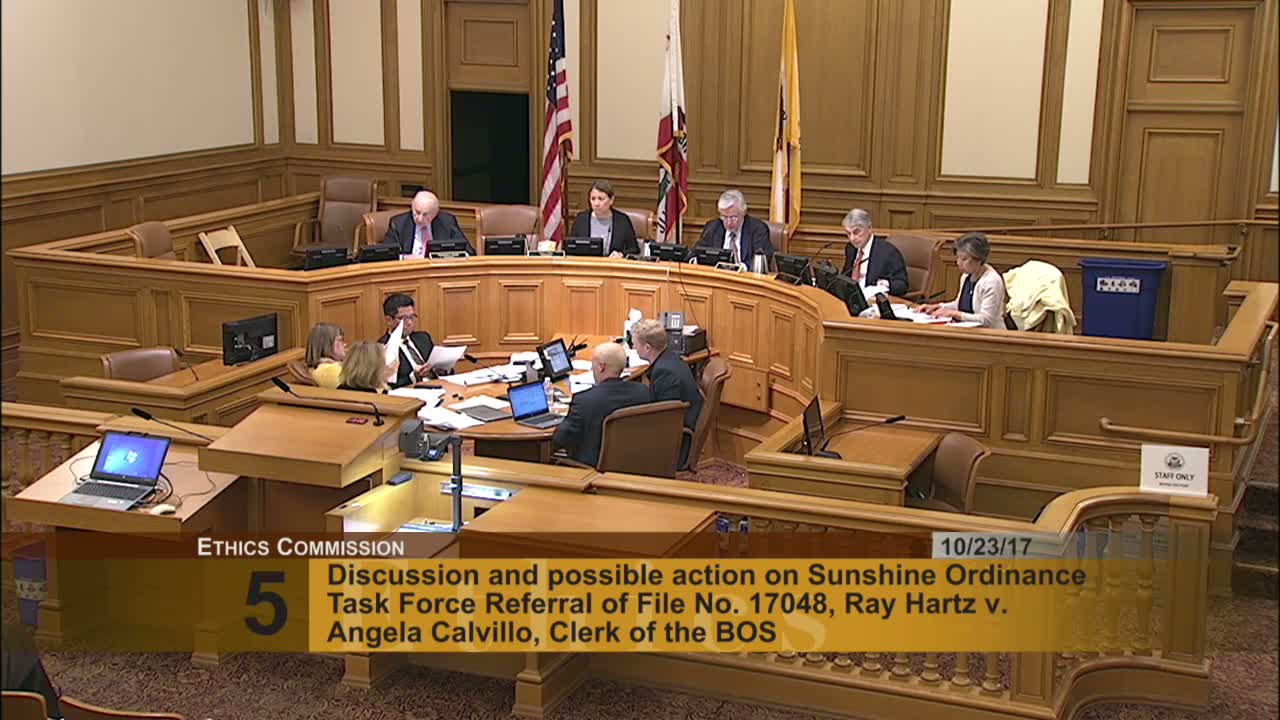
Commissioner Sandra Chiu (identified in the record as Commissioner Chu) moved that the commission "accept the staff memo, except for these modifications," laying out a package of changes staff should draft into final ordinance language for the Commission's next review. The motion, seconded and debated through the evening, passed 4–1.
Why it matters: The ordinance package under discussion aims to limit 'soft' pay‑to‑play practices city officials and stakeholders say steer decisions away from the merits. The measures under consideration include expanding contribution restrictions on city contractors and land‑use parties, clarifying when officials may solicit charitable or in‑kind support, and how enforcement should operate. Replacing a prohibition with a stronger disclosure regime means the practice would be made visible to the public and the commission rather than broadly outlawed immediately.
What the Commission directed staff to do: Commissioner Chiu—s motion instructed staff to prepare ordinance text that, among other items, would: - Keep a longer (12‑month) time window for certain contractor restrictions and set a higher numeric threshold for applicability (staff direction included a $100,000 threshold in the motion); - Retain, for now, the proposed restrictions on parties with a financial interest in land‑use matters (section 1.127 as discussed in the staff memo); - Remove the provision that would have awarded 50 percent of civil penalties collected in successful citizen suits to the private plaintiff, leaving injunctive remedies and attorney—s‑fee rules in place (staff had voiced concern this monetary incentive could foster frivolous litigation); - Narrow the fundraising restriction for board and commission members back toward prohibiting fundraising for appointing authorities rather than broadly banning fundraising for all elected officials; and - Replace the proposed ban on behested payments (requests by an official that a person with a matter before them convey value to a third party) with a robust disclosure regime and a stepped set of reporting requirements for behested solicitations.
Debate highlights and reasoning: Commissioners who favored a ban argued that officials using their position to solicit contributions or in‑kind support from persons with matters before them creates a structural corruption risk even where no explicit quid pro quo is proven. Chair Keane framed the issue as preventing officials from ‘‘putting the arm on’’ potential contributors and thereby distorting decisions. Opponents argued a blanket ban could sweep in legitimate public‑benefit partnerships and volunteer solicitations and that a disclosure regime would provide empirical evidence to assess the problem before imposing broad prohibitions.
Staff role and next steps: Staff (policy analyst Patrick Ford and city‑attorney deputies present in the meeting) were directed to return with precise draft ordinance text implementing the Commission's directives and a strengthened disclosure proposal for behested payments. Commissioners signaled they expected staff to work with stakeholders on the mechanics (attestation forms, notice to contractors/grantees, and reporting formats) and to bring final legal language back for consideration at a subsequent meeting.
Process and vote: The motion was made from the dais and seconded; after extensive public comment and back‑and‑forth among commissioners, it passed 4–1. The Commission—s action was to provide policy direction — not to adopt final ordinance text that evening. Staff will draft changes in ordinance form for later formal action.
Provenance: Commission discussion and vote are recorded in the Commission packet discussion under agenda item 6, introduced at the meeting (topic appears from SEG 1725 through SEG 4533 in the public transcript). Key public commenters on this agenda item included community speakers and representatives of nonprofit coalitions who urged either a strong ban or rigorous disclosure and monitoring.
What to watch: Watch for staff's next draft ordinance text implementing the disclosure regime for behested payments and for the final language the Commission will consider in a later meeting. The change from a ban to disclosure will shift the policy debate from immediate prohibition to data collection and public monitoring before further restrictions might be adopted.