Get Full Government Meeting Transcripts, Videos, & Alerts Forever!
Get email alerts on the Enforcement Regulations topic
No spam. Unsubscribe anytime.
Ethics staff previews enforcement‑regulation rewrite, including delegated probable‑cause process
Summary
Staff proposed a package of enforcement‑rule changes: place investigations under the enforcement director, delegate formal probable‑cause findings to the executive director, eliminate a duplicative accusation document, make stipulated settlements public (with a consent calendar for small settlements), allow default orders and codify late‑filing fees.
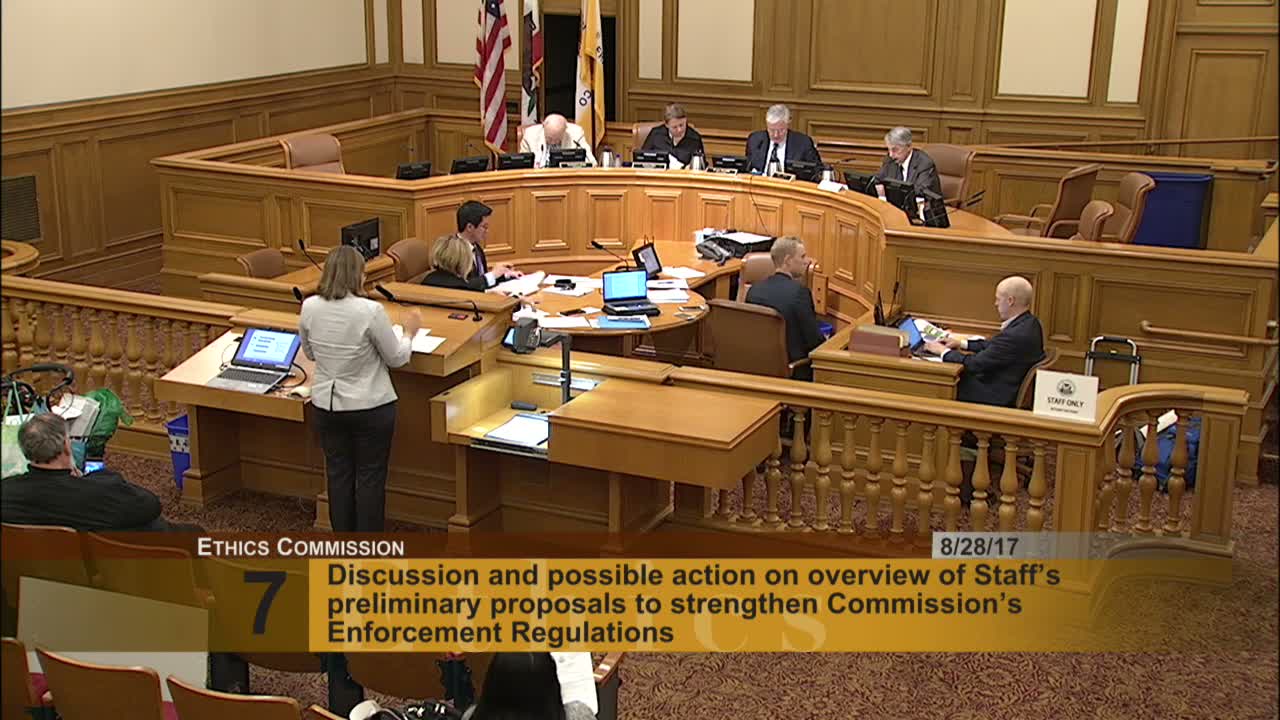
At the Aug. 24 meeting the commission's executive director previewed a substantive rewrite of enforcement regulations intended to increase efficiency, transparency and accountability in the commission’s investigative process.
The major proposals are: (1) assign day‑to‑day investigation conduct to the enforcement director (the deputy director) while preserving the executive director’s subpoena authority; (2) delegate formal probable‑cause determinations to the executive director after a probable‑cause conference, mirroring practice at the state FPPC and reducing a secretive full‑panel probable‑cause step; (3) eliminate the separate public ‘‘accusation’’ document that duplicates the charging record; (4) make stipulated settlement agreements public and create a consent calendar for settlements below a monetary threshold to streamline processing while preserving public comment and the right of commissioners to pull items for discussion; (5) allow the commission to enter default orders when respondents fail to appear after proper notice; and (6) codify the late‑filing‑fee waiver and accrual rules currently in policy.
The executive director said drafts will be circulated internally and to stakeholders and that the commission will host interested‑persons meetings in September with regulatory notice and a potential November vote after the required three‑week regulatory notice period. Commissioners generally welcomed the approach as an improvement in transparency and due process while noting key safeguards should be preserved for respondents.
Selected quote: “We would agendize stipulations, and then you would consider them in public with the public being able to comment...This makes staff more accountable,” the executive director said.
Next steps: Staff will publish draft regulations, host interested‑persons meetings in September, issue the required regulatory notice and return a final proposed regulation for the commission’s consideration in November.