Get Full Government Meeting Transcripts, Videos, & Alerts Forever!
Get email alerts on the Ethics Prop J topic
No spam. Unsubscribe anytime.
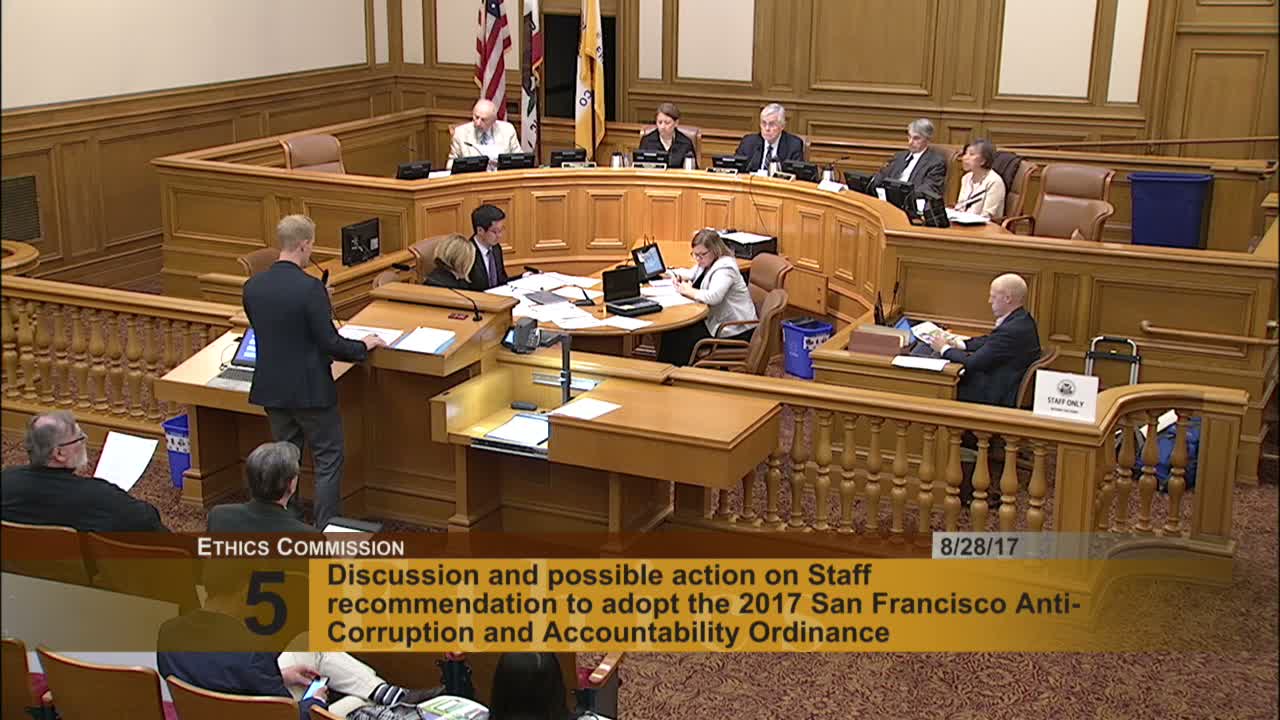
Ethics commission delays final vote on sweeping anti‑corruption ordinance after hours of testimony
Summary
After a broad staff proposal to revive and expand Proposition J drew extensive questions and more than two hours of public comment — especially from nonprofits worried that a ban on 'behested payments' could choke charitable fundraising — the Ethics Commission voted to continue the measure to its next meeting to allow staff to publish and refine the amendments.
The San Francisco Ethics Commission on Aug. 24 paused action on a comprehensive anti‑corruption ordinance that would revive and expand aspects of the city’s old Proposition J, after hours of questioning from commissioners and sustained public comment from nonprofit providers.
Chair Keane framed the proposal as an effort to reinstate protections against “soft corruption” the city lost after Prop J was scaled back in the 2000s. The draft before the commission would broaden prohibitions beyond contractors and consolidate new disclosure and enforcement tools, including a process for debarment recommendations and changes to citizen‑suit provisions. Chair Keane moved to adopt the staff statement with three specific changes he proposed: restore a private right of action in line with Los Angeles law, broaden the ordinance’s reach beyond land‑use and contracts to a wider class of public‑benefit recipients, and add commissioner fundraising restrictions borrowed from Los Angeles.
Staffer Kyle Cundard outlined practical changes the commission has proposed in recent months, saying the draft aims to balance constitutional limits and stronger disclosure: “The citizen plaintiffs would provide us, the city attorney or the district attorney with notice, that they were going to file a complaint,” Cundard said, describing the 60‑day notice window and the commission’s review role under the staff draft.
Commissioners asked detailed constitutional and operational questions — for example, how debarment recommendations would be carried out (staff is proposing departments do the debarment), whether stockholders or bondholders count as persons with a "financial interest" (staff proposed a roughly 10% ownership threshold in a project/property), and how a proposed pre‑election report would capture late campaign spending.
Public testimony stretched for hours. Nonprofit leaders who contract with the city urged the commission to narrow the draft’s definition of "behested payments" so routine fundraising is not chilled. Debbie Lerman of the San Francisco Human Services Network told commissioners: “This proposal would hamstring the ability to raise money,” warning the draft could prevent elected officials from endorsing or speaking on behalf of charities at events and could bar volunteer board members from contributing.
Supporters of tougher rules, including Friends of Ethics, pressed the commission to preserve strong remedies aimed at limiting pay‑to‑play behavior and large, targeted behested donations announced by officials. Charlie Marsteller of Friends of Ethics emphasized archival evidence and data his group had compiled documenting large single donations requested or solicited by city officials.
The commission also addressed an internal procedural matter during the discussion: newly appointed Commissioner Yvonne Lee asked to be recused from voting on the item because she had not participated in prior meetings; the commission voted to allow her recusal for this matter.
After extended deliberation and public comment — including repeated requests from community organizations for clearer drafting and additional interested‑person meetings — Commissioners Chu and Rennie moved to continue the ordinance to the commission’s next meeting to permit staff to post the precise amended language and to hold additional outreach. The motion to continue passed by roll call and the commission left the item open for further refinement.
Next steps: Staff will circulate a written version of the Chair’s three proposed amendments, hold additional interested‑persons meetings, and return with a revised draft for the commission’s consideration at the following meeting.
Who said what (selected quotes)
• Chair Keane: “I would recommend to my colleagues that we keep that private right of action.”
• Kyle Cundard (staff): “The citizen plaintiffs would provide us, the city attorney or the district attorney with notice, that they were going to file a complaint.”
• Debbie Lerman (San Francisco Human Services Network): “This proposal would hamstring the ability to raise money.”
What this matters means: The ordinance would change local campaign, disclosure and conflict rules including who is covered by pay‑to‑play limits and how civil enforcement or private suits could proceed. The continuation gives civil society groups, staff and commissioners time to narrow definitions and resolve constitutional and administrative questions before a final recommendation goes to the Board of Supervisors.
The meeting record: The commission formally continued deliberation and did not adopt the ordinance at this meeting; the item is scheduled to return at a later date for further consideration.