Get Full Government Meeting Transcripts, Videos, & Alerts Forever!
Get email alerts on the Prop J Restoration topic
No spam. Unsubscribe anytime.
Ethics commission moves draft to restore parts of Prop J, seeks public vetting
Summary
The commission presented a draft ordinance to restore parts of Proposition J (2000) that would broaden prohibitions on personal or campaign advantages tied to public decisions and add disqualification and debarment provisions; commissioners asked staff and the city attorney to run interested‑persons meetings before any final vote.
The San Francisco Ethics Commission on March 22 unveiled a draft to restore elements of Proposition J, the 2000 voter measure limiting certain gifts and campaign advantages for officials, and agreed to pursue interested‑persons meetings and city‑attorney review before deciding whether to send the proposal to the Board of Supervisors.
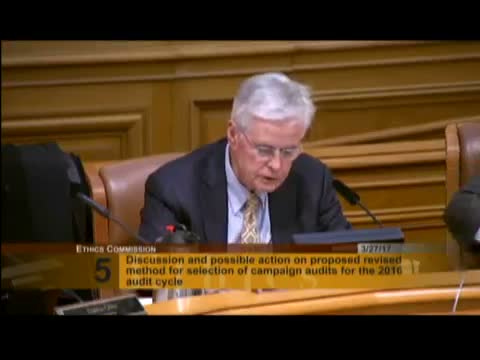
Chair Keane, who introduced the effort and said he did not expect the commission to vote on the draft at the meeting, framed the work as a measured restoration of voter intent. "I would not anticipate voting on this tonight because it's such an important measure, and should be vetted more by the people of San Francisco," Keane said.
Oliver Luby, who helped draft the restoration language, told commissioners the proposal aims to expand provisions in the Campaign Finance Reform Ordinance (CFRO) — notably section 1.126 — to cover a wider set of "public benefit decisions" (not only contracts) and to prohibit a broader set of "personal or campaign advantage" transactions. Luby said the draft also borrows enforcement and consequence elements from other jurisdictions, including a disqualification period modeled on Richmond law and a debarment provision recommended by the Campaign Legal Center and drawn from Los Angeles law.
Key features described by staff and speakers include restoring a prohibition on transfers between controlled committees not formed for the same office, expanding who is covered to include agents and financially interested persons, and aligning penalties so 1.126 violations carry parity with other CFRO violations (e.g., the greater of $5,000 or triple the amount illegally provided or received in the most significant violations).
Public speakers and advocacy groups including Friends of Ethics and Friends of Ethics representatives urged restoring provisions they said were removed or narrowed in subsequent code changes after 2000. Larry Bush and other commenters argued the changes would close perceived loopholes that allow contractors and their agents to influence decisions without directly making prohibited contributions; they called for clear disclosure rules and stricter enforcement.
Commissioners questioned thresholds in the draft (for example, the use of a $50,000 contract/disclosure threshold in some sections) and asked staff to consult the city attorney. Commissioner Rennie and others urged timely outreach and study. The city attorney's office said it would work with staff to provide legal analysis but cautioned a full review of the complex ordinance would require more time than the commission's next meeting in order to surface legal issues.
Next steps: the commission directed staff to hold interested‑persons meetings, asked the city attorney for legal review, and scheduled further discussion at a future meeting before any formal submission to the Board of Supervisors or placement on the ballot.
Why it matters: Supporters said restoring and modernizing Prop J would reduce the appearance or reality of pay‑to‑play influence in land‑use and contracting decisions and increase public confidence in city decision‑making. Critics warned the city attorney and staff should vet the draft so any enforcement mechanisms are clear and legally sound.
The commission did not vote on the draft at this meeting; it will return for additional staff, legal and public review before taking formal action.