Get Full Government Meeting Transcripts, Videos, & Alerts Forever!
Get email alerts on the Grants topic
No spam. Unsubscribe anytime.
Fire Commission backs retroactive NSF and state grants to bolster community paramedicine and buprenorphine access
Summary
The commission recommended that the Board of Supervisors retroactively authorize two grants — $205,200 (NSF via San Jose State) for research on equity and moral injury and $217,500 (state funds via Sierra Health Foundation/California Paramedic Foundation) to expand buprenorphine and opioid/stimulant treatment initiatives.
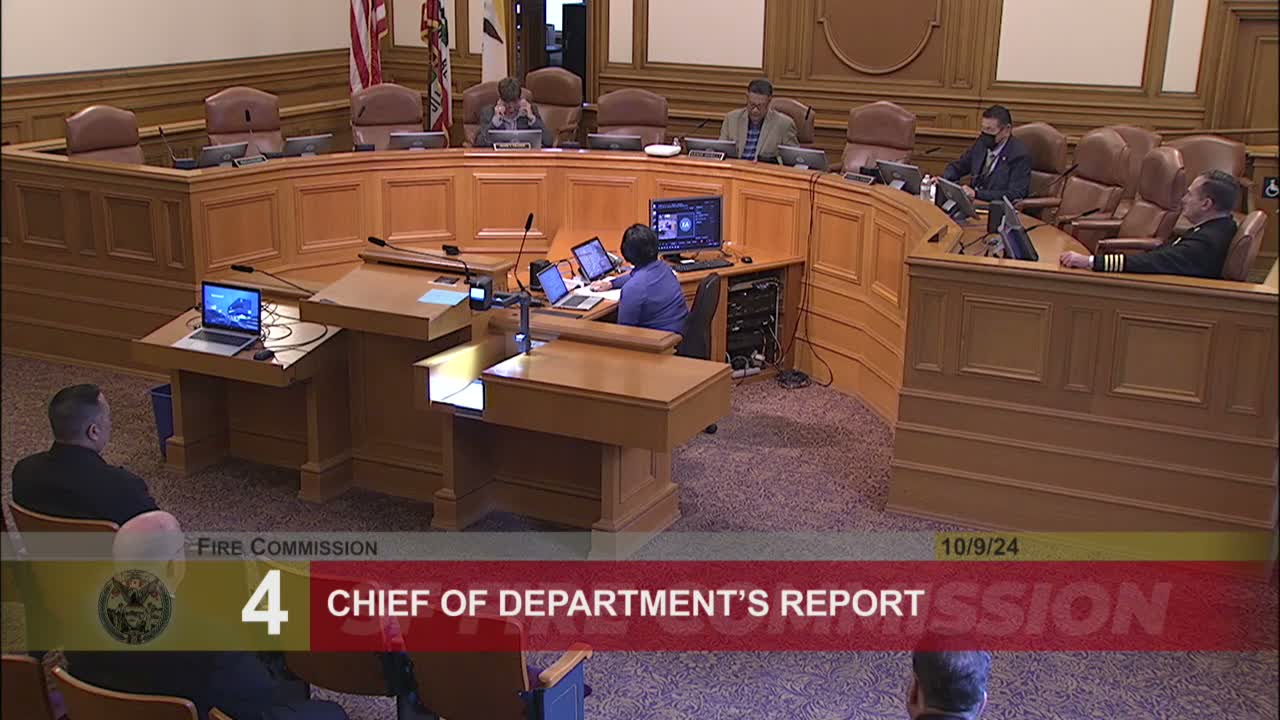
The Fire Commission on Oct. 9 recommended that the Board of Supervisors retroactively authorize two grant awards to support the San Francisco Fire Department’s community paramedicine work.
Mark Corso, finance and planning, described Resolution 2024‑43: a $205,200 National Science Foundation subaward administered through San Jose State University to support a pilot study aimed at improving equity in emergency medical services and interrupting moral injury and burnout among community paramedicine staff. "This is a partner pilot study with San Jose State University to enhance equity in emergency medical services and mitigate a moral injury amongst first responders," Corso said.
Commissioners then considered Resolution 2024‑44, a $217,500 award flowing from the California Department of Health Care Services through Sierra Health Foundation and the California Paramedic Foundation to expand prevention, treatment and access to medication‑assisted treatment, including prehospital buprenorphine. Corso described why the authorization is retroactive: training and program activity began before the subaward paperwork was completed, and the department is requesting the Board of Supervisors’ retroactive approval.
Commission discussion focused on the retroactive nature of the requests and on ensuring the department’s training was documented; commissioners asked whether similar grants had come before the body previously and confirmed the two items would be voted on separately. Commissioner Frasier moved the NSF recommendation and the motion carried. The California Department of Health Care Services grant also passed on a separate motion.
The resolutions instruct the city to accept and expend the funds; both are recommendations to the Board of Supervisors and are retroactive requests to cover work already under way. The commission did not change the substance of either grant but required the usual Board authorization process for expenditure and acceptance.
Next steps: the items are forwarded to the Board of Supervisors for formal authorization and execution. The department and finance staff were present to answer implementation and training questions.