Get Full Government Meeting Transcripts, Videos, & Alerts Forever!
Get email alerts on the Emergency Medical Services topic
No spam. Unsubscribe anytime.
Fire Department flags ambulance offload delays, new training and policy revisions
Summary
Deputy Chief Simon Pang told the Sept. 11 Fire Commission the department’s 90th‑percentile ambulance patient‑offload time is about 35 minutes with a goal of 30; about 40% of hospital transports are delayed and the department will implement new protocols Oct. 1 alongside policy changes tied to Senate Bill 43.
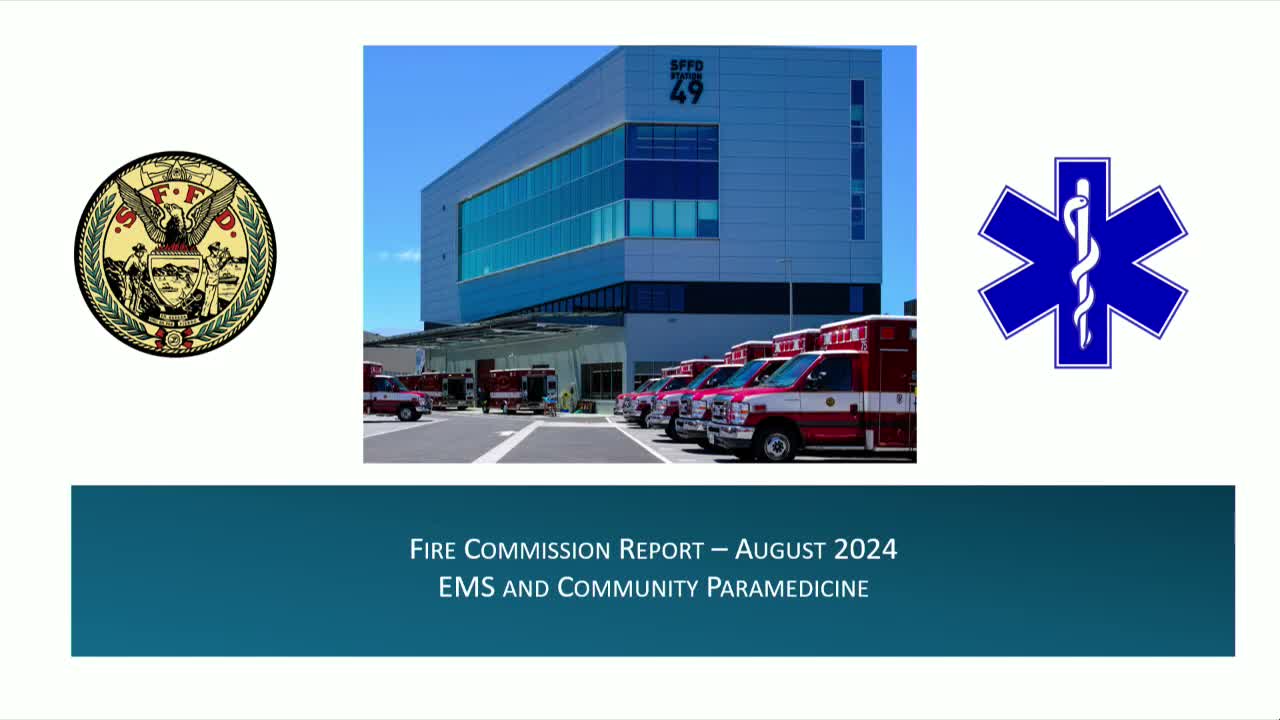
Deputy Chief Simon Pang, who introduced himself as the new head of EMS and community paramedicine at the Sept. 11 San Francisco Fire Commission meeting, said ambulance patient‑offload times remain a critical operational constraint and outlined training and policy steps the department will take.
"Our ninetieth percentile offload time is about 35 minutes, and we will be working to reduce that to about 30 minutes," Pang told commissioners, adding that "approximately 40% of all our transports to hospitals are delayed over 30 minutes." He said in August the department recorded what he believed were "over 20 incidents when our ambulances were delayed over 2 hours," a problem that reduces available ambulances for emergency response and strains operations.
Pang cited Assembly Bill 40 — approved by Gov. Newsom last year — which "stipulates that hospitals must work collaboratively with local EMS agencies to find ways to reduce offload times," and said city EMS leaders are coordinating with hospital directors to pursue improvements.
The deputy chief highlighted the department’s clinical outcomes and staff training: "One out of three times for those individuals that we attempt resuscitation, we managed to get a return of spontaneous circulation upon arrival at the hospital," Pang said, noting this rate aligns with national averages. He also recognized Paramedic Santino Guerrero and EMT Thomas Knott for a case in August in which a patient "walked out of the hospital," and listed a second team whose response led to a patient being stabilized and transferred for rehabilitation.
Pang outlined a two‑part training push beginning Oct. 1: department‑wide instruction on newly adopted protocols and a mobile training team visiting stations to teach advanced airway techniques. He identified a set of clinicians and captains leading that in‑field training.
On community paramedicine, Pang said targeted outreach — for example signing seniors up for lifeline programs and connecting high‑utilizers to conservatorship when appropriate — produced measurable drops in frequent 911 use. He pointed to Senate Bill 43, which "has expanded the definition of who meets the criteria for an involuntary mental‑health hold," and said the department has been meeting weekly with the San Francisco EMS Agency to revise two policies that will take effect Oct. 1 to improve pathways for people who need care off the street.
Commissioners praised the work and asked follow‑up questions about hospital capacity and unusually long offload events; Pang attributed the longest delays primarily to hospital staffing and bed availability and said the department is pursuing collaborative solutions.
The department said it will continue reporting APOT metrics and policy changes to the commission as the Oct. 1 training and policy revisions take effect.