Get Full Government Meeting Transcripts, Videos, & Alerts Forever!
Get email alerts on the Sunshine Taskforce Warning topic
No spam. Unsubscribe anytime.
Ethics commission warns Sunshine Task Force, finds public-information officer violated ordinance
Summary
The Ethics Commission found a violation of the Sunshine Ordinance in Joel Warney's complaint against a Department of Public Health public information officer and voted to send a warning letter; staff and Task Force witnesses described systemic backlog issues that delayed processing of 67.21/67.25 matters.
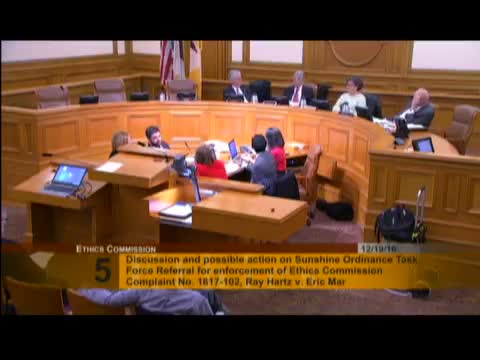
The San Francisco Ethics Commission voted Dec. 19 to find a violation of the Sunshine Ordinance in a complaint brought by Joel Warney against a Department of Public Health public information officer and to issue a warning letter documenting the finding.
Staff presented a review showing that Warney, a former patient at San Francisco General Hospital, had not received timely responses to multiple public-records requests. Staff recommended issuing a letter of warning to the respondent and documenting a finding that the Sunshine Ordinance had been violated. "We concluded that Mr. Warney was correct that the task force does frequently miss its deadlines," staff told the commission and recommended limited sanction options (cease-and-desist, public posting or a warning), recommending a letter of warning.
Bruce Wolf, incoming chair of the Sunshine Ordinance Task Force, told the commission the Task Force had experienced a backlog caused in part by an unfilled required appointment and that the Task Force had adjusted its scheduling and complaint-committee practices to reduce delays. Wolf said some misses of the 45-day rule in the record were by a small margin and that the Task Force had made operational changes to prevent future delays.
Commissioners debated whether the absence of the original complainant at the Ethics Commission meeting reduced the urgency of enforcement. The staff recommendation was moved and seconded and the commission voted to accept it; the motion carried unanimously (recorded as "4 Zip").
The commission directed staff to post the finding and send the warning letter, noting that the Task Force had acknowledged systemic scheduling and backlog problems and had begun internal changes to address them.