Get Full Government Meeting Transcripts, Videos, & Alerts Forever!
Get email alerts on the Employee Health topic
No spam. Unsubscribe anytime.
New department physician outlines wellness exams, EHR plan for SFFD employees
Summary
Dr. Steven Chang, the department physician, told the commission the Office of Employee Health will launch annual wellness exams driven by members and primary‑care providers, move from paper charts to an EHR, and start a continuous quality‑improvement process.
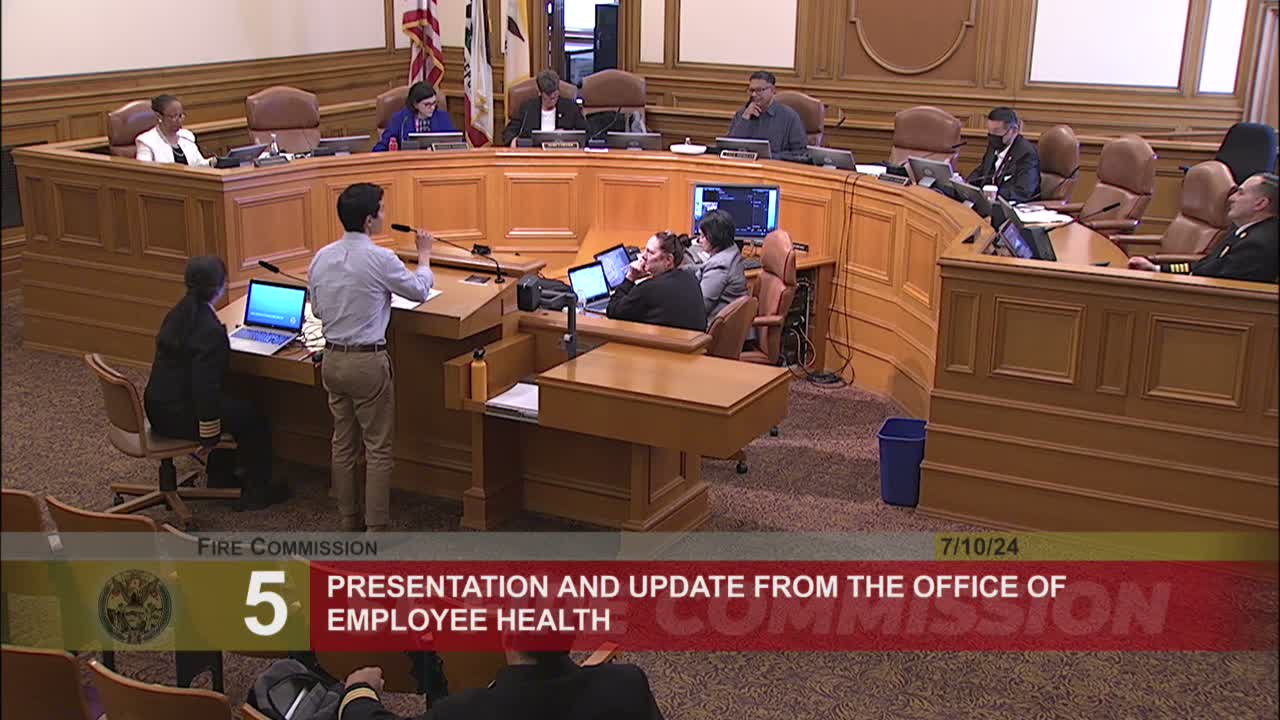
Dr. Steven Chang, the San Francisco Fire Department’s new department physician, presented an update from the Office of Employee Health, outlining plans to expand preventive care for employees, adopt an electronic health record and establish continuous quality improvement.
Chang said the office has already conducted pre‑employment, promotional and end‑of‑probation exams and is refreshing the clinic space to make it more welcoming. He described a new annual wellness exam program — member‑ and primary‑care‑provider driven — that will include physical and mental health checks, lab work and cancer screenings when appropriate, with the expectation that the member’s primary care provider will perform the exam and provide a signed attestation rather than sharing sensitive medical records directly with the department.
Chang said the office still uses paper charts and is actively evaluating EHR vendors with support from Director Mark Corso and IT manager Jesus Mora. The department plans a CQI process to track measurable health outcomes for members and to increase outreach for screenings and immunizations; the office offers flu and COVID vaccinations when available but does not mandate them.
Commissioners raised questions about data sharing, confidentiality and how occupational risks — including elevated cancer risk tied to firefighting exposures and PFAS in turnout gear — will be tracked and mitigated. Chang said the move to PFAS‑free turnout gear and preventive screening are important measures to reduce cancer risk.