Get Full Government Meeting Transcripts, Videos, & Alerts Forever!
Get email alerts on the Sunshine Ordinance topic
No spam. Unsubscribe anytime.
Ethics Commission declines to find Planning officials violated Sunshine Ordinance indexing rule
Summary
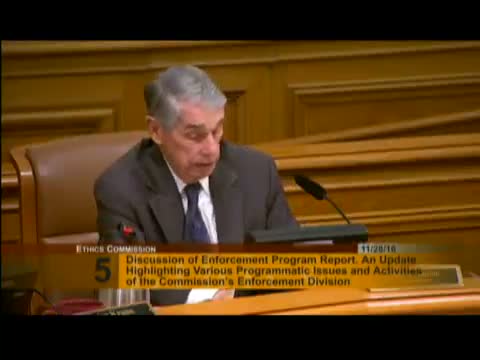
After a lengthy public exchange over whether Planning populated mandated indices for CEQA-related records, the San Francisco Ethics Commission accepted staff and city attorney advice and voted 4–0 that the named Planning officials did not willfully violate the Sunshine Ordinance.
The San Francisco Ethics Commission on Nov. 28 accepted a staff recommendation and voted 4–0 that two Planning Department officials did not willfully violate the city’s Sunshine Ordinance by failing to populate the index of CEQA-related records.
The complaint arose after public commenter and complainant Mr. Grossman said the Planning Department had created but not filled the indexes required by Administrative Code section 67.29, leaving the public without meaningful access to records and internal notes for environmental reviews such as the Better Streets Plan amendment. Grossman told the commission he had filed multiple records requests and found gaps and little documentary evidence of the agency’s deliberations.
Staff and the city attorney countered that the text and structure of section 67.29 place the city administrator — not individual planning employees — with primary responsibility for maintaining an index of public records. Staff’s memorandum, which the commission accepted, said nothing in the Sunshine Ordinance or CEQA requires the creation of the specific CEQA-compliance document the complainant sought and that the Planning Department’s record handling did not amount to a willful ordinance violation. The city attorney explained the index obligation is a citywide duty, and staff urged the commission to limit its inquiry to whether the named respondents had willfully violated the ordinance.
Commissioners questioned how the statutory index requirement should operate in practice and whether the public’s right of access under California’s constitution implies a heavier duty to provide online materials. Some commissioners and public speakers said the indexing system is confusing and suggested clearer online access would better serve the public. Staff said the commission’s available remedies are limited: it can order respondents to cease-and-desist, produce records, post findings on the commission website, or issue warning letters; the commission has no penalty authority under the ordinance.
After discussion, a commissioner moved to accept the staff recommendation to find no violation; the motion carried unanimously. The commission recorded the outcome as accepting staff’s analysis that, based on the evidence presented, the two named respondents had not willfully violated the Sunshine Ordinance.
The commission’s decision closes this administrative complaint but, as staff noted, it does not foreclose other legal remedies the complainant may pursue under CEQA or other statutes. Staff also advised the commission that questions about how indices are maintained and how agencies post materials online could be addressed through policy review or by urging the city administrator’s office to clarify index implementation.
The commission moved on to other complaints and agenda items after the vote.