Get Full Government Meeting Transcripts, Videos, & Alerts Forever!
Get email alerts on the Sunshine Ordinance topic
No spam. Unsubscribe anytime.
Ethics commission deadlocks on finding that supervisor willfully ignored public-records request
Summary
The San Francisco Ethics Commission considered a Sunshine Ordinance Task Force referral alleging a supervisor failed to respond to an Immediate Disclosure Request filed in March 2015; the commission split 2–2 on a motion to sustain the Task Force's finding of a willful violation and the motion failed.
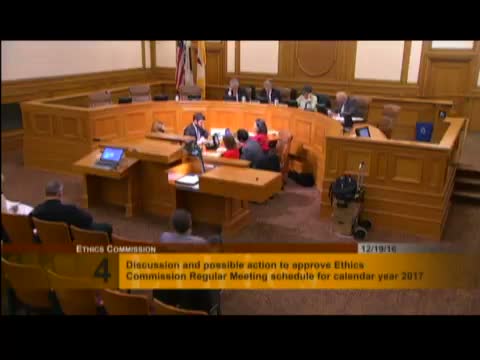
The San Francisco Ethics Commission on Dec. 19 considered a Sunshine Ordinance Task Force referral alleging that a supervisor failed to respond to an Immediate Disclosure Request (IDR) filed in March 2015 and that the delay amounted to a willful violation of the city's Sunshine Ordinance. The commission voted on a motion to sustain the Task Force's finding of willful violation but the motion failed on a 2–2 tie.
Complainant Ray Hartzbechter, who filed the original IDR and subsequent complaints, told the commission the supervisor's office did not provide a written response for "a year and four months" and repeatedly failed to appear at Task Force hearings. "Basically, this was the facts are that he willfully ignored the law," Hartzbechter said during his presentation to the commission.
Angelina Yu, a legislative aide speaking for the supervisor, said the delay resulted from administrative oversight and staffing arrangements rather than intentional misconduct. "There's not been a willful intent to violate the ordinance nor to willfully fail to discharge the duties," Yu said, adding that the office had since instituted procedures to flag and respond to IDRs and that representatives subsequently attended Task Force hearings.
Commissioners pressed the Maher office representative on how incoming IDRs were routed and who was responsible for opening and monitoring requests; Yu said the office split monitoring among aides and that, at the time in question, procedures were informal and partly kept on notepads. Commissioners also queried whether the Task Force had the full record and noted that recordings of prior Task Force hearings could help clarify what was presented when the Task Force made its willfulness finding.
After deliberation, Commissioner Keane moved to sustain the Task Force's determination that the supervisor committed a willful violation; the motion was seconded. The motion failed on a 2–2 vote, with the chair calling that the motion "did not carry." Commissioners who opposed sustaining willfulness emphasized the need to review exactly what the Task Force had before it at the time of its decision and whether Maher's office had put forward the same explanations at that hearing as it did at the Ethics Commission.
The commission did not adopt a willful-failure finding and left the record as presented. The complainant urged additional enforcement options and noted that, under the ordinance, willful failure can be deemed official misconduct though the commission's practical remedies are limited to cease-and-desist orders, website postings of findings and warning letters.