Get Full Government Meeting Transcripts, Videos, & Alerts Forever!
Get email alerts on the Sunshine Ordinance topic
No spam. Unsubscribe anytime.
Commission debates mayoral staff calendar deletions; requests records recovery but accepts staff finding of no ordinance violation
Summary
After public testimony that mayoral chief of staff deleted electronic calendar entries, the commission authorized staff to ask city departments whether deleted calendar entries can be recovered and unanimously adopted staff’s recommendation that the Ethics Commission lacked jurisdiction to find a willful Sunshine Ordinance violation by Steve Kawa.
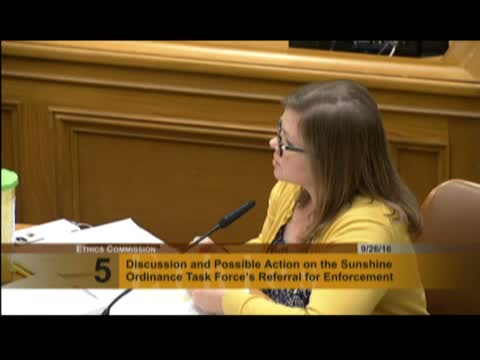
The San Francisco Ethics Commission spent much of its Sept. 26 meeting considering a Sunshine Ordinance Task Force referral that alleged the mayor’s chief of staff had deleted portions of his electronic calendar, impeding public records access.
Public advocate Michael Petrellis laid out the complaint, displaying calendar pages and arguing that entries for parts of 2015 were blank or deleted. Petrellis urged the commission to compel investigators to move on the complaint and to make records-retention rules explicit in writing.
Staff (Jessica Blum) told the commission the task force found that Mr. Kawa had deleted calendar entries and referred the matter for enforcement, but the city attorney’s office argued that many employee electronic communications are not "city records" under the city’s records-retention framework. Blum explained the commission’s authority rests in Chapter 67 (the Sunshine Ordinance), while criminal enforcement of records-retention violations is with the district attorney or attorney general. She said the staff’s memorandum treats Kawa’s electronic calendar as a public record but noted legal limits on remedies and recommended the commission consider policy changes to the Sunshine Ordinance by asking the Board of Supervisors to clarify retention obligations.
Steve Kaba from the mayor’s office (introducing himself as present on behalf of the mayor’s office) said that at the time in question his practice (or his office’s practice) had been to retain calendar entries for two weeks and then delete them; he said the office has since started retaining calendars and welcomed clarification so that city staff uniformly know what to keep.
Commissioners debated two distinct questions: (1) whether, as a matter of law, the Sunshine Ordinance requires calendar retention by senior mayoral staff not specifically covered by Proposition G, and (2) whether Mr. Kaba’s conduct amounted to a willful Sunshine Ordinance violation. After discussion the commission took two actions. First, it authorized the chair to send a staff-drafted letter to relevant departments asking whether the requested calendar records could be recovered from backups or servers. Second, the commission voted to accept staff’s recommendation that Mr. Kaba did not willfully violate the Sunshine Ordinance as written (the motion adopting staff’s recommendation passed unanimously).
Several public commenters urged stronger enforcement and legislative changes; a number of commissioners said the matter pointed to a gap between record-retention practice and transparency goals and suggested the commission pursue policy work to clarify retention obligations and enforcement options.
Next steps: staff will send the authorized letter inquiring about technical recovery of deleted records and will return with any response. The commission also directed staff to prepare follow-up work on possible amendments or recommendations for the Board of Supervisors to clarify retention duties and enforcement mechanisms under the Sunshine Ordinance.