Get Full Government Meeting Transcripts, Videos, & Alerts Forever!
Get email alerts on the Disclosure Behested Payments topic
No spam. Unsubscribe anytime.
Proposal would require commissioners to disclose large solicited charitable donations
Summary
Supervisor Peskin proposed expanding behested payment reporting (disclosure of solicitations above $5,000) to commissioners and board members; staff and commissioners debated scope, timing (quarterly vs. 30 days) and narrow exemptions for nonprofit fundraising staff to avoid chilling civic participation.
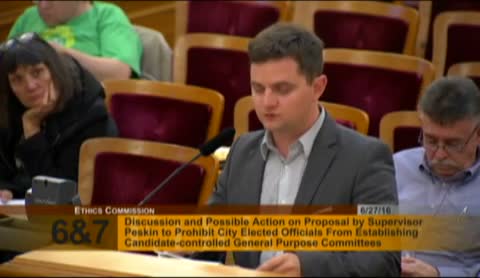
A proposal introduced by Supervisor Aaron Peskin would extend existing behested payment reporting requirements to city commissioners, requiring disclosure when a commissioner solicits or receives $5,000 or more for charitable or government-related purposes.
Peskin—s office framed the measure as a transparency step to shed light on solicitations that could create perceived conflicts when donors have business before a commissioner—s body. Staff described potential amendments to allow online filing of reports (not necessarily Form 803), to permit quarterly reporting with expedited disclosure for solicitations from interested parties, and to add a narrow exemption for professional nonprofit fundraisers who solicit as part of their compensated duties (but require disclosure when the donor is an interested party coming before a commission).
Commissioners asked for examples and cautioned about breadth: they were concerned a blanket rule could require disclosure of routine fundraising for schools or small nonprofits and could impose resource burdens on staff for review and processing. Public commenters from the nonprofit sector urged a narrow exemption to avoid deterring nonprofit leaders from serving on commissions and explained donor confidentiality concerns for vulnerable client populations.
Staff said the commission already enforces a reporting regime for elected officials and that the extension would expand that requirement; they agreed to return in July with draft language and operational cost implications. No final vote was taken.