Get Full Government Meeting Transcripts, Videos, & Alerts Forever!
Get email alerts on the Public Financing topic
No spam. Unsubscribe anytime.
Staff report finds third‑party spending dominated San Francisco’s 2015 public‑financing races
Summary
Staff told the Ethics Commission that in the 2015 election third‑party spending equaled roughly 96% of candidate spending in the races analyzed; staff recommended reviewing program mechanics after repeatedly lifting candidate spending limits during that cycle.
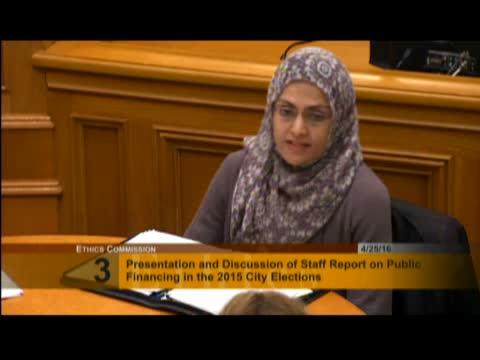
Staff presented the 2015 public‑financing report at the April 25 meeting, outlining program mechanics, participation rules and key metrics and urging a program review in light of rising independent expenditures.
Assistant Deputy Executive Director Shaista Shaikh described the program’s qualifying rules in 2015: non‑incumbent candidates had to demonstrate $10,000 in qualifying contributions from at least 100 city residents (incumbents a higher threshold of $15,000 from 150 residents) to be eligible for public funding. Participating candidates agreed to a $250,000 spending cap that the Commission may raise in $10,000 increments based on third‑party spending and opponents’ fundraising.
Shaikh highlighted how mechanics played out in 2015’s two participating races: both candidates received the maximum public financing allocation (up to $155,000), yet their final expenditure ceilings were raised repeatedly during the campaign — staff reported lifting the ceiling 21 times for one candidate and 29 times for another. Candidate spending in those races totaled about $480,000 and $594,000 respectively, with third‑party spending totaling roughly $1,000,000.
In response to a charting error, staff corrected a figure in the packet: the percentage of third‑party spending as a proportion of candidate spending in 2015 is 96%, not 65%, a correction staff said it would include in the published report.
Why it matters: Staff said the pattern of high independent spending and frequent cap increases raises questions about whether the program’s mechanics achieve their intended goals — especially the aim of reducing fundraising pressure and increasing competitiveness. Commissioners and members of the public said the topic warrants broader discussion, candidate and treasurer input, and possible adjustments to program rules.
Next steps: Staff offered to convene stakeholder meetings, consult treasurers and candidates, and return with recommendations about whether to adjust qualification thresholds, trigger mechanisms for cap increases, or other rules to better achieve program aims. Audits of the two participating candidates in 2015 were reported to be underway and expected by the end of the fiscal year.
Representative quotes: "On chart 4 ... it's not 65%. It's actually 96," Shaikh said, referring to a corrected table included in the packet.
The Commission invited public comments and signaled interest in a careful, evidence‑based review before proposing regulatory changes.