Get Full Government Meeting Transcripts, Videos, & Alerts Forever!
Get email alerts on the Campaign Finance topic
No spam. Unsubscribe anytime.
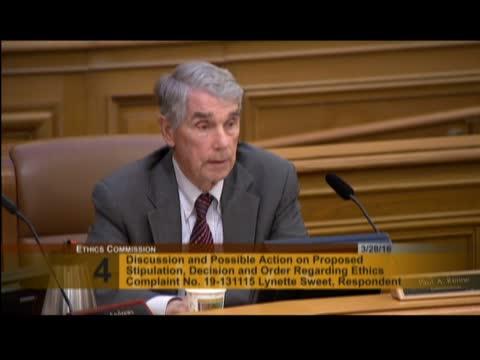
Ethics panel approves $9,250 stipulation in Lynette Sweet campaign audit over staff objections
Summary
The San Francisco Ethics Commission voted 3–2 to approve a stipulation resolving an audit-related enforcement matter involving Lynette Sweet, a publicly financed 2015 candidate. Staff reported about $20,000 remained unaccounted for; the fine and payment plan prompted questions from commissioners and public commenters about sufficiency and enforceability.
The San Francisco Ethics Commission voted 3–2 on March 28 to approve a proposed stipulation and order resolving enforcement action arising from an audit of Lynette Sweet’s publicly funded 2010 campaign committee (district 10).
Garrett Chatfield, an investigator on the commission staff, told commissioners the mandatory audit found three material findings and that about $20,000 remained unaccounted for after the candidate later provided additional documentation. Chatfield said Sweet had received $57,439 in public funds and that staff proposed a settlement amount of $9,250, higher than a recent comparable stipulation because investigators found the candidate initially was uncooperative.
Commissioners and public commenters pressed staff about the basis for the penalty, the missing funds, and the ability to collect. Members noted prior stipulations with similar violations and asked whether the proposed fine reflected the amount unaccounted for; staff said the commission’s prior comparable settlements guided the recommendation and that the proposed agreement included a payment plan and an ability to reopen the matter if the respondent missed payments.
Several members of the public, including speakers who identified themselves with advocacy groups, said the penalty appeared low compared with the amount unaccounted for and asked whether the commission could demand return of missing public funds or require more robust follow-up. Staff replied that the full range of statutory penalties (up to $5,000 per count or three times the amount raised or spent, per the code cited to the commission) remained available if the commission rejected the settlement and pursued a hearing.
After public comment and questions—on whether the audit report and campaign ID should be included in future materials, the adequacy of the payment plan, and the candidate’s financial circumstances—the commission approved the staff recommendation by recorded voice vote with three ayes and two noes.
The commission’s action resolves the administrative stipulation as presented; commissioners left open the option to reopen the matter or pursue further investigation if required by future developments. The decision was taken at the conclusion of the agenda item addressing ethics complaint no. 19-113115.