Get Full Government Meeting Transcripts, Videos, & Alerts Forever!
Get email alerts on the Prop C Regulations topic
No spam. Unsubscribe anytime.
Ethics Commission adopts Prop C implementing rules after heated debate over staff-time reporting and small-nonprofit burdens
Summary
The commission approved multiple implementing regulations for Proposition C, adopting a rule that counts payments at the time an influencing activity occurs, shortening the look-back window, and clarifying member/newsletter exemptions. Commissioners debated whether staff salaries should count toward the $2,500 threshold and approved a fee waiver for smaller 501(c)(3) groups, amid sustained public comment raising concerns about burden on grassroots nonprofits.
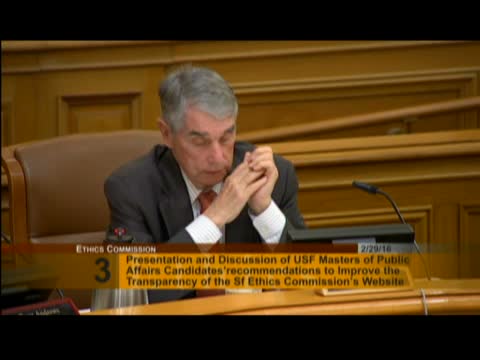
The San Francisco Ethics Commission spent the bulk of its Feb. 29 meeting debating draft regulations to implement Proposition C and adopted several measures to clarify when payments count as expenditure lobbying, how to treat staff time and membership communications, and which small nonprofits qualify for a registration fee waiver.
After staff presented the draft, commissioners focused on Section 2.105-5, which defines when a payment toward expenditure lobbying is considered "made." Commissioners agreed to revised language tying the trigger to the date an activity to solicit or urge communication with city officials "takes place" rather than solely the date a vendor invoice is incurred. The commission also shortened the staff-proposed 12-month look-back to six months in the final motion.
Why it matters: Proposition C creates a new category of expenditure lobbyists who must register and report when they spend $2,500 or more in a calendar month on activities that urge others to contact city officials; these implementing rules determine how organizations track payments and what items trigger registration and reporting. The decisions affect large corporations and small advocacy groups differently and prompted extended public testimony.
A central conflict at the hearing was whether salaries and internal staff time should count toward the $2,500 monthly threshold. Several commissioners and commenters argued counting salaries would capture in-house advocacy by large corporations; others — including a long series of nonprofits, labor unions and community organizations — warned the requirement would impose heavy administrative burdens and chill grassroots civic engagement. "The proposed rule requiring the tracking and reporting of staff time as expenditure lobbying would impose an extraordinary burden," Jody Schwartz, executive director of Lyric, said. Deepa Varma of the San Francisco Tenants Union said the rule would "kill the grassroots," stressing many small groups lack accounting capacity.
Commissioners resolved this by adopting staff language that excludes ordinary salaries from the computation for the $2,500 registration threshold (the commission removed optional language that would have counted salaries in some circumstances). Chair Rennie and several commissioners framed that change as balancing transparency with practical burdens for small organizations.
The commission also debated the definition of "member" and an exemption for communications primarily directed to members. After public input and discussion, the commission narrowed and clarified the exemption: "member" will include an employee or shareholder, a person who pays dues or fees, or any person who affirmatively requests to regularly receive an organization’s communications. A broader newsletter exemption in staff’s draft was removed.
On administrative filings, the commission approved conforming changes to registration and reporting forms and adopted clarifying language that payments are considered "made" when the activity to solicit or urge occurs (staff will incorporate grammatical cleanups noted by commissioners).
On fees, commissioners amended a regulation to waive the $500 registration and reregistration fee for smaller nonprofits — limiting the waiver to 501(c)(3) organizations that file Form 990-N or 990-EZ or can demonstrate budgets under $500,000. The fee-waiver amendment passed unanimously (5–0).
Formal outcomes and next steps: the commission approved Regulation 2.105-5 (payment timing, 6-month look-back, deletion of 'single matter' aggregation language), adopted Regulation 2.105-6 (member/newsletter exemption language as amended), approved registration/reporting form language with payment-definition conforming edits, and approved the small-nonprofit fee-waiver standard. Commissioners also agreed to continue the whistleblower-protection ordinance item to the March meeting to allow more public input.