Get Full Government Meeting Transcripts, Videos, & Alerts Forever!
Get email alerts on the Department Report topic
No spam. Unsubscribe anytime.
SFFD highlights recruitment surge, training and rising fleet costs in monthly report
Summary
Chief Janine Nicholson and Deputy Chief Shane Kayaloha told the Fire Commission the department is convening interagency meetings on ambulance offload problems, preparing a late-June academy class after hundreds of applicants, expanding training partnerships and grappling with rising equipment and fleet replacement costs.
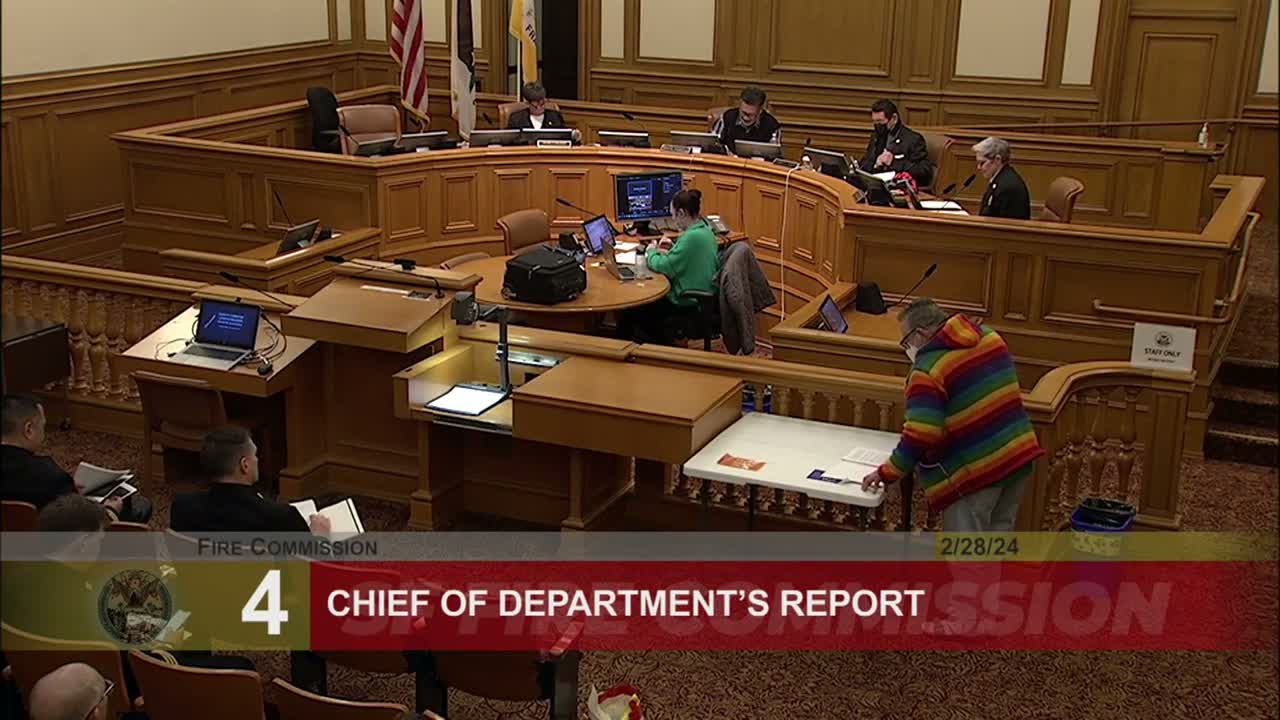
The San Francisco Fire Department told its Fire Commission on Feb. 28 that it is pressing interagency partners for help with ambulance patient offload times and is moving ahead with large recruitment and training efforts while managing growing fleet and infrastructure costs.
Chief Janine Nicholson said the department has been meeting with the San Francisco Municipal Transportation Agency and other partners to assess projects that affect emergency response and has asked to participate in meetings led by hospitals and the mayors office on ambulance-patient offload time, or APOT. She also said the department is working with the Human Rights Commission and several historically Black colleges and universities on internship placements.
"We are doing candidate selection for the next academy. Interviews begin on Friday. We will be interviewing 130 people for the class that begins in late June," Nicholson said. She listed outreach and recruitment efforts and thanked staff who organized the departments participation in recent community events.
Deputy Chief Shane Kayaloha presented administrative data for January and said recruitment for the 130th class attracted 747 applicants, of whom 556 were eligible and invited to panel interviews and 491 attended panel interviews; more than 100 advanced to chief-level interviews. Kayaloha said the department has transitioned recruiting and testing processes and is partnering with outside organizations for training and outreach.
Commissioners asked for clarification about the applicant counts after spotting a discrepancy in meeting materials; Kayaloha confirmed the presentation figure of 491 interviewees rather than a lower figure that appeared elsewhere.
The department also reported operational and capital concerns. Deputy Chief Mike Mullins said engine and truck prices and long delivery timelines are a vulnerability: "We are just over $2,000,000 for a truck," Kayaloha said, and an engine is estimated at about $1,100,000 with delivery time exceeding 600 days. The commission was told Fire Station 35 received a bronze design award and that the fiscal-year 2024 roofing program had $500,000 allocated to address envelope and water intrusion projects at stations.
Health and safety topics included occupational cancer awareness and prevention campaigns, behavioral-health-unit contact hours and continued work on a lactation policy and a draft chaplaincy program. The department said it ordered 400 additional drug- and alcohol-testing kits and clarified that blood-based testing is used for new hires while saliva is used for random testing and some promotional processes.
Next steps: staff will continue interagency meetings on APOT, follow up on recruitment and provide details requested by commissioners about specific counts and timelines.