Get Full Government Meeting Transcripts, Videos, & Alerts Forever!
Get email alerts on the Executive Director Selection topic
No spam. Unsubscribe anytime.
Ethics Commission moves to closed session for executive director interviews after public raises missing public-financing funds
Summary
At a special meeting to interview candidates for a new executive director, the San Francisco Ethics Commission voted unanimously to enter closed session; public commenters praised Prop C and one alleged that public financing funds from prior ballot measures were missing and urged city-attorney review.
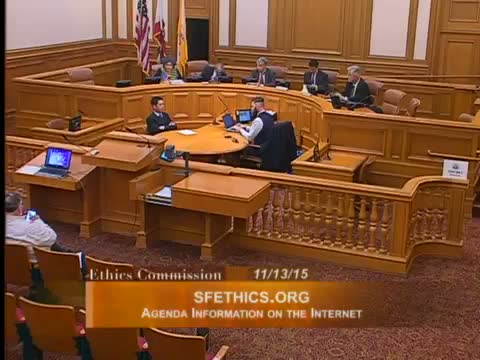
SAN FRANCISCO — The San Francisco Ethics Commission held a special meeting to continue interviews and consider the appointment of a new executive director and voted unanimously to go into closed session for the interviews.
The chair asked for a motion to move into closed session “for the interviews and selection process,” which was moved and seconded on the record. After a brief public-comment period, the commission voted in favor and the chair said the panel expected to return to public session “not earlier than 03:00, but probably around 03:00 or shortly thereafter.”
The public-comment period drew broad praise for Proposition C and repeated calls for leadership change inside the commission. Lynn Beason, introduced herself and thanked the commission for Prop C, saying the commission’s work “is as important as any work or more in this city” and urging new leadership without ‘criticism.’ Alainie Schmidt thanked the commission for a public process in selecting an executive director and said the city needs someone who can change staff culture. Sharon Slavsky said she concurred with Schmidt and thanked the commission for placing Prop C on the ballot.
A public commenter raised a separate concern about San Francisco’s earlier public-financing framework, referencing the 2000 Proposition O and the CFRO system. That commenter said delays in adjudication since 2010 had left the program “highly vulnerable to a press attack” and alleged that “those monies are missing,” urging the commission and the city attorney to examine whether there are legal or criminal implications. The commission did not address specifics of the allegation in public; Commissioner Keane asked for a short historical capsule from the city attorney and the chair said staff would inquire and try to calendar the matter for a future meeting.
Charlie Marsteller, speaking for the record, urged the commission to seek a leader with international experience, saying leadership at the staff level has been “far lacking” relative to the city’s global role and suggesting the new executive director should have stature with both the public and city officials.
The commission’s action on the record at the special meeting was procedural: a motion to go into closed session for candidate interviews and the selection process. The commission announced no public votes on appointments or policy items during the session; next public steps will depend on the outcome of the closed-session interviews.
The commission’s meeting materials and public record indicate references to Proposition O (2000) and Proposition C (date not specified in the record), and multiple commenters asked the commission to consider the timeliness and enforcement of campaign-finance adjudications when evaluating candidates for executive director. The allegation about missing public-financing funds was raised during public comment and was not resolved in the meeting. The chair indicated staff would follow up and that the commission hoped to reconvene in public around 3 p.m.