Get Full Government Meeting Transcripts, Videos, & Alerts Forever!
Get email alerts on the Post Employment Waiver topic
No spam. Unsubscribe anytime.
Ethics panel grants limited waiver to former deputy city attorney Evan Gross, denies one‑year cooling‑off relief
Summary
The San Francisco Ethics Commission granted a permanent‑ban waiver allowing Evan Gross to represent nonprofit affordable‑housing clients on transactional matters but denied his request to waive the one‑year prohibition on communications with city colleagues, 4–1. The commission heard hours of testimony from housing officials and community groups before voting.
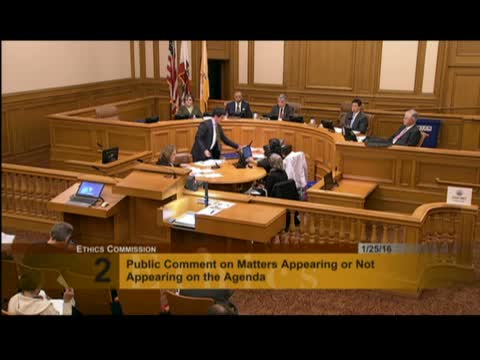
The San Francisco Ethics Commission on Jan. 25 granted a limited waiver of a lifetime prohibition for former deputy city attorney Evan Gross that would allow him to represent nonprofit affordable‑housing developers in transactional, non‑litigation matters but denied a separate request to waive the one‑year cooling‑off restriction on communications with his former city colleagues.
Gross told the commission he applied for the waiver to continue specialized transactional work he said the city still needs. “Granting this waiver would not create a potential for undue influence or unfair advantage,” Gross said, adding that the City Attorney’s Office had already issued a professional‑responsibility waiver and that his new firm does not engage in litigation.
City housing officials and major nonprofit developers urged the commission to grant the waivers, saying the affordable‑housing pipeline in San Francisco depends on a small pool of specialized lawyers who understand federal and state funding rules as well as the city’s underwriting practices. Olsen Lee, director of the Mayor’s Office of Housing and Community Development, told commissioners that the city’s long, public underwriting and bond approval processes reduce the risk that any single outside counsel could exercise undue influence: “We have a level of public scrutiny on those transactions that would highlight any conflict,” Lee said.
Commissioners pressed Gross and the City Attorney’s Office on whether a waiver could allow a lawyer to effectively “switch sides” in active litigation. Andrew Schenk, a deputy in the City Attorney’s Office, told the panel his office had reviewed the matter and granted a waiver limited to non‑litigation, transactional activity. Several commissioners said they were persuaded to allow the permanent‑ban waiver but remained concerned about the one‑year perception and the revolving‑door optics.
After extended public testimony and discussion, a motion to grant a waiver to section 3.234(a)(1) — which would otherwise permanently disqualify a former city attorney from representing private parties on matters in which they had been substantially involved — passed on a 4–1 vote. The commission separately voted 4–1 to deny a waiver of the one‑year restriction under section 3.234(a)(2), meaning Gross may not communicate with former city colleagues on city matters for one year.
The commission’s action leaves Gross able to do specified transactional work on San Francisco projects for his nonprofit clients, subject to the litigation carve‑out identified by the City Attorney’s Office. The panel said staff will update the record with the specific limitations and findings required by the ordinance. The commission also recorded public concerns about appearance and precedent, and some members urged clearer rules for future waiver requests.
The commission recessed after the votes and moved on to other agenda items scheduled for the evening.