Get Full Government Meeting Transcripts, Videos, & Alerts Forever!
Get email alerts on the Community Paramedicine topic
No spam. Unsubscribe anytime.
San Francisco’s community paramedicine program wins state approval; EMS sees rising demand
Summary
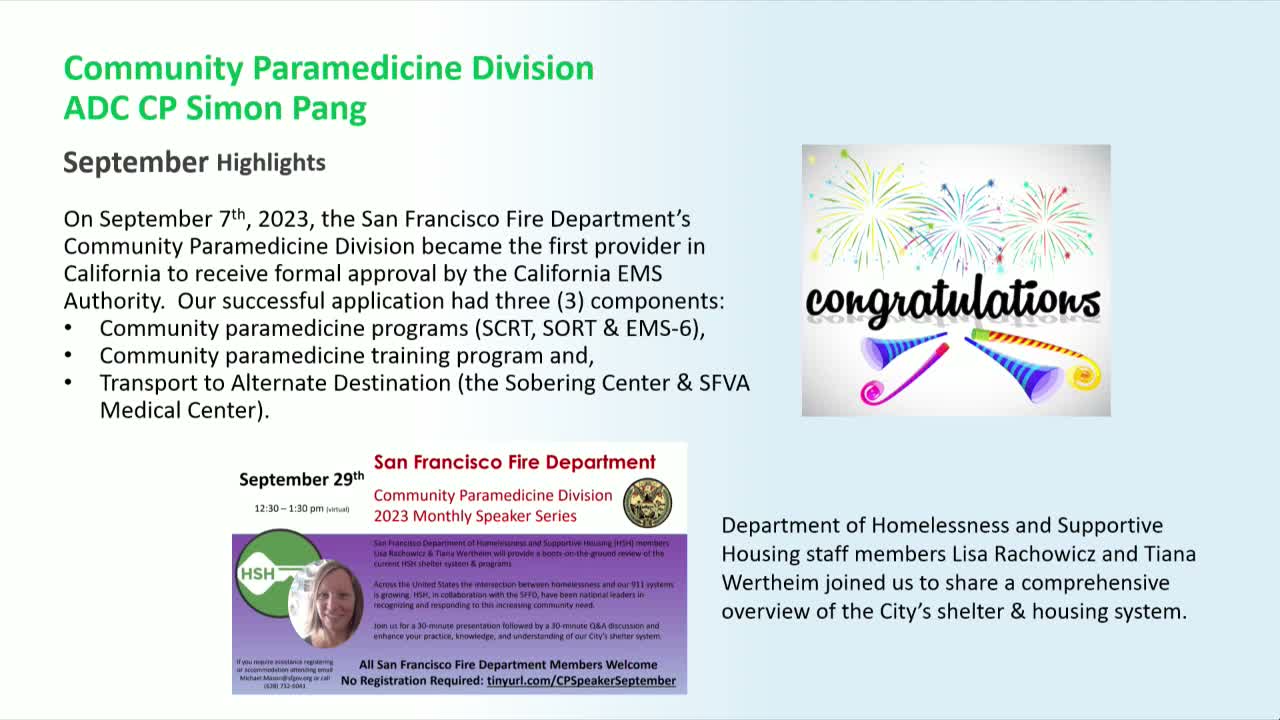
Deputy Chief Sandy Tong told the Fire Commission that the department’s community paramedicine program received formal approval from the state under AB 1544, moving street teams and EMS 6 out of pilot status even as call volumes tick up and transport times remain lengthy.
Deputy Chief Sandy Tong told the San Francisco Fire Commission on Oct. 25 that the San Francisco Fire Department’s community paramedicine program has received formal state approval, transitioning previously piloted services into an authorized local program.
"The San Francisco Fire Department Community Paramedicision became the first provider in California to receive formal approval of our community paramedicine programs," Tong said, citing the legislative and regulatory framework that allowed local emergency medical services agencies to authorize such programs. Tong referenced AB 1544 and said the department worked with the local EMS agency and the state EMSA to meet the program criteria.
Tong also summarized EMS operations in September: the division averaged about 370 calls per day (a 3.4% rise from August) and continued to expand staffing as four new level-2 paramedics graduated and six EMTs advanced to paramedic rank. Tong said the department has reinstated in-person in-service training for ALS providers and is pacing paramedic staffing improvements alongside operational needs.
On measures of time in service, Tong clarified that the "transport" average includes total call time from dispatch to back-in-service, and so long transport averages may reflect hospital turnaround and other delays as well as travel.
Operational outcomes tied to community responses were also noted: the department and SORT teams recorded roughly one 5150 hold per day in September and have broadened training so community paramedics can initiate holds where appropriate; teams also recorded about 40 Suboxone administrations during the period described.
What’s next: the department will continue to implement the approved community paramedicine program, expand training and report operational metrics to the commission; commissioners asked for further details on shared dashboards and data-sharing with other city agencies.