Get Full Government Meeting Transcripts, Videos, & Alerts Forever!
Get email alerts on the Campaign Finance Committee Limits topic
No spam. Unsubscribe anytime.
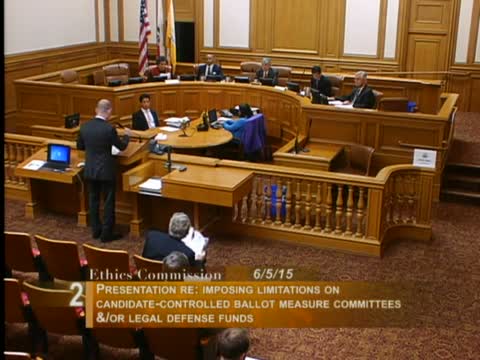
Ethics commission hears experts on limits for candidate-controlled ballot measure committees and legal defense funds
Summary
Experts and public commenters urged the San Francisco Ethics Commission to consider limits on candidate-controlled ballot measure committees and legal defense funds, citing appearance-of-corruption and transparency problems; legal counsel warned of constitutional barriers under U.S. Supreme Court precedent.
Deputy Director Jesse Minardi told commissioners the body had asked staff to investigate whether San Francisco should limit how much candidate-controlled ballot measure committees and legal defense funds can raise. The hearing featured longtime reform advocate Bob Stern and political scientist Corey Cook.
Bob Stern, a principal drafter of California political reform initiatives, told the commission candidate-controlled committees and legal defense funds should face contribution limits equal to those applied to candidate committees. Stern said limits reduce both actual corruption and the appearance of corruption and estimated ‘‘90% of campaign money comes from people who want something from government.’’ He argued legal defense funds can be used as a vehicle for special-interest support and should be subject to the same ceilings as campaign committees.
Corey Cook, an associate professor who has studied San Francisco campaign finance, said candidate-controlled committees frequently concentrate large donations and can ‘‘prime’’ voters on issues to benefit a candidate’s future campaigns. Cook recommended stricter disclosure, clearer restrictions on coordinated spending and ensuring funds are spent for stated ballot-measure advocacy rather than generic activities that raise a candidate’s profile.
Anita Mayer, outside counsel, cautioned that limits on ballot measure contributions face serious First Amendment obstacles. Citing Citizens Against Rent Control v. City of Berkeley, she said limits on contributions to committees advocating ballot measures risk infringing freedom of association and expression unless narrowly tailored. Mayer also argued that tight limits on legal defense funds could undercut officials’ access to adequate counsel.
Public commenters from Friends of Ethics presented spreadsheets showing large-dollar contributions to candidate-controlled committees in recent cycles and urged the commission to consider a ballot measure or ordinance to close perceived loopholes. Commission staff and several commissioners noted that any local change could require voter approval or a charter amendment, rather than being imposed by regulation alone.
The commission did not adopt a policy at the meeting; members directed staff to continue the analysis and noted options including (1) ballot-placed charter or ordinance changes, (2) tighter disclosure and reporting rules, and (3) spending restrictions to ensure money is used for measure advocacy rather than general political infrastructure.