Get Full Government Meeting Transcripts, Videos, & Alerts Forever!
Get email alerts on the Campaign Finance Forfeiture topic
No spam. Unsubscribe anytime.
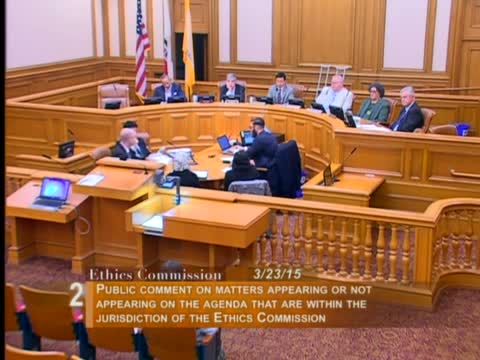
Ethics Commission hears arguments over $191,000 forfeiture demand tied to Mark Farrell campaign
Summary
The Ethics Commission reviewed a staff forfeiture letter seeking roughly $191,000 tied to independent expenditures that Commission staff say benefited Mark Farrell; Farrell’s counsel urged waiving the demand, citing a four-year statute of limitations and an FPPC stipulation that counsel said exonerates Farrell.
The San Francisco Ethics Commission on the agenda considered a staff forfeiture letter sent to Supervisor Mark Farrell that asks for repayment tied to independent-expenditure activity during his campaign.
Counsel for Supervisor Farrell, Mr. Sutton, told the Commission the request should be waived. "Supervisor Farrell has done absolutely nothing wrong," Sutton said, and he argued the Fair Political Practices Commission (FPPC) investigation and interviews did not show that Farrell or his campaign knowingly accepted illicit funds. Sutton further told the Commission staff that the four-year statute of limitations would bar forfeiture at this point and that forfeiture is a remedy typically reserved for cases that require no investigation (for example, where a reporting form on its face shows an over‑limit corporate contribution).
Commissioners pressed staff and counsel on the available remedies. Commissioner Keane queried what remedy exists if an ostensibly independent committee is later found to have been controlled by a candidate’s committee; Keane said that if contributions were part of a controlled committee, the $500 contribution limit is strict liability and asked why further investigation would be necessary to determine whether the limit was exceeded. Sutton replied that administrative fines, stipulations and other enforcement tools exist and that forfeiture is generally appropriate only where no investigation is required.
Members of the public urged a stricter approach. Several commenters, including advocates from San Francisco Open Government and Friends of Ethics, argued the FPPC stipulation and parts of the record show a controlled-committee relationship and pressed the Commission either to pursue forfeiture or to clarify control-committee rules to prevent similar cases going forward.
Staff and several public speakers cited key factual and procedural points: the staff letter referenced an approximate $191,000 figure alleged to have been spent by an independent expenditure committee in support of Farrell; the Commission’s own enforcement policy and past practice use a four‑year limitations period; and the FPPC entered a stipulation concerning consultant Chris Lee that some commenters characterized as an admission that the independent committee was controlled. Counsel for Farrell disputed characterizing the stipulation as evidence that Farrell’s committee directly received or possessed the $191,000 and emphasized differences between remedies available after full investigation versus those applied to straightforward reporting admissions.
No formal forfeiture decision was taken at the meeting. Commissioners received counsel’s written response and heard public comment and questions; staff indicated the matter would proceed in accordance with Commission policy and the staff’s enforcement process.
Next steps: staff will continue to manage the enforcement path for the matter, and the Commission signaled it expects additional legal and factual work (including review of the FPPC record and internal policy guidance) before taking any final enforcement action.