Get Full Government Meeting Transcripts, Videos, & Alerts Forever!
Get email alerts on the Campaign Finance topic
No spam. Unsubscribe anytime.
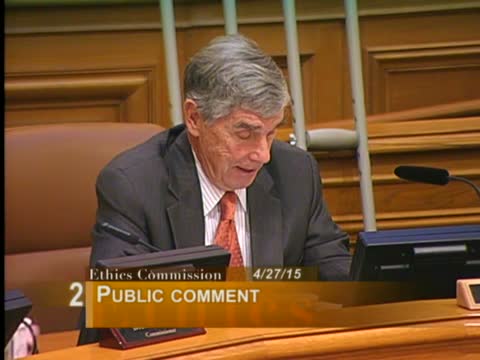
Ethics Commission blocks staff's waiver letter, keeps forfeiture on track in Mark Farrell matter
Summary
After hours of debate over statutes of limitation and enforcement procedure, the San Francisco Ethics Commission voted 4-1 to block an executive director's draft waiver letter regarding a forfeiture demand tied to Supervisor Mark Farrell's 2010 campaign and to allow staff 30 days to justify any waiver before referral to the Bureau of Delinquent Revenue.
The San Francisco Ethics Commission voted 4-1 on its April agenda to prevent staff from sending a draft letter that would waive a forfeiture demand arising from alleged improper campaign-related expenditures tied to Mark Farrell's 2010 campaign. Commissioners said they want clearer legal rationale before the city closes the matter administratively.
The matter centers on a forfeiture letter the executive director issued in December 2014 seeking reimbursement tied to roughly $190,000 in coordinated spending by a committee the Fair Political Practices Commission later sanctioned. Commissioner Keane summarized the complaint as "a $200,000 illegal campaign contribution" and argued the commission should not waive the sanction without substantive justification.
Why it matters: The Commission's decision keeps active an administrative pathway that could lead to collection through the Bureau of Delinquent Revenue (BDR) and preserves the option for judicial review of statute-of-limitations questions. Public speakers and several commissioners framed the issue as an enforcement test of the city's campaign rules and of the commission's willingness to hold powerful actors to account.
What the Commission did: After hearing legal arguments and extended public comment, Commissioner Keane moved that the executive director, John St. Croix, not send the proposed waiver letter; the motion was seconded and carried 4-1. Commissioner Hurd (the lone dissent) said he would not authorize a waiver without seeing an explicit, well-documented rationale in the letter and favored a policy that would require Commissioners to approve waivers above a certain dollar threshold.
What happens next: The Commission also voted 4-1 to suspend immediate referral to BDR for approximately 30 days while staff may (if it chooses) prepare a fuller written justification for any waiver recommendation. If staff does not return with additional rationale within that period, the matter will proceed along the ordinary forfeiture/collection path; if staff submits a justification, the Commission will place the matter on a future agenda for consideration.
Key claims and responses: Commissioner Keane and several public commenters pointed to the FPPC stipulation and the FPPC's fine as evidence of serious violations; Jim Sutton, representing Supervisor Farrell, disputed assertions that Farrell or his consultants operated the independent committee and underscored the FPPC and city attorney's prior, extensive investigations. Commissioners repeatedly emphasized procedure and the limit of the Commission's role in adjudicating statute-of-limitations questions, noting that courts ultimately resolve those legal questions if litigated.
The Commission did not rule on merits (whether the city should impose civil penalties) and did not reverse staff's authority in all future waiver requests; instead it required clearer written justification when staff recommends administrative waivers in high-dollar or legally complicated matters. The matter remains active pending staff action or referral.