Get Full Government Meeting Transcripts, Videos, & Alerts Forever!
Get email alerts on the Campaign Finance Transparency topic
No spam. Unsubscribe anytime.
Volunteers from Code for America’s SF Brigade show new campaign‑finance visualizer
Summary
Members of the SF Brigade showed transparentvoting.com, an open‑source visualization of Form 460 and lobbying data that lets users explore contributions, expenditures and lobbying contacts by candidate or proposition. Commissioners praised the project and asked about sustainability and data quality.
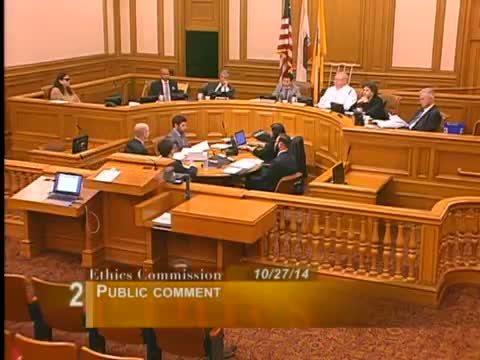
Members of the SF Brigade, a local volunteer group affiliated with the nonprofit Code for America, demonstrated transparentvoting.com at the San Francisco Ethics Commission meeting on Sept. 22. The site draws on the city’s open data to show fundraising totals, expenditures and lobby‑contact records for Board of Supervisors candidates and local ballot measures.
"What they do is they try to bring people who are working in technology together with civic groups that need help," Asha John, an SF Brigade volunteer, told the commission as she walked through visualizations of Schedule A (contributions) and Schedule E (expenditures). The demonstration highlighted trends by date, donor type (individuals, PACs, recipient committees) and a heat map linking lobbying contacts to contributions.
Commissioners asked whether the brigade’s work is permanent, how the project will be sustained and whether users can generate their own correlations on the site. Steven Eberling and Peter Hall, both volunteers on the project, said the SF Brigade’s output is open source and that Code for America retains project artifacts; the current site does not allow arbitrary end‑user correlation queries but the volunteers said that capability is a possible future enhancement. The presenters also described a downstream data store (DKAN) the group uses to host processed, enriched datasets that add geographic information to lat/long coordinates.
Staff and public commenters praised the volunteers but flagged data‑quality challenges. David Pilpelt and others noted inconsistencies in how campaigning entities report names and addresses in Form 460 filings, which the presenters said requires manual reconciliation to produce reliable visualizations. The volunteers said they will publish a GitHub repository and a link on transparentvoting.com to share code and invite collaboration with journalists and other civic technologists.
The commission thanked the volunteers and asked staff to provide a permanent link from the Ethics Commission’s resources to the project. Commissioners also encouraged continued outreach to reporters and other cities; staff reported interest from other California jurisdictions and from Seattle in adopting similar dashboards.
The demonstration concluded with an invitation to review the site at transparentvoting.com and to provide feedback on clarity and usability.