Get Full Government Meeting Transcripts, Videos, & Alerts Forever!
Get email alerts on the Conflict Of Interest Waiver topic
No spam. Unsubscribe anytime.
Ethics Commission denies waiver for Arts Commissioner with large-firm ties, 3'to'1
Summary
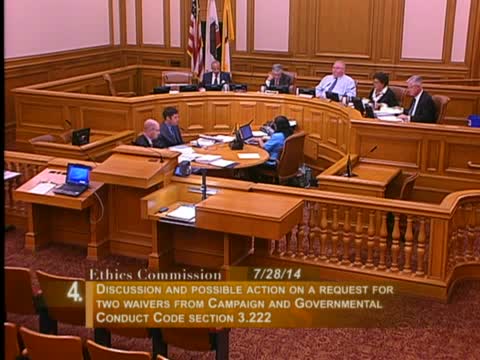
The Ethics Commission voted 3'to'1 on July 28 to deny two limited waivers requested by Arts Commissioner Leo Chow (transcript variants: Chao/Chow) under Campaign and Governmental Conduct Code §3.222, citing appearance-of-conflict concerns despite arguments that recusal practices could manage actual conflicts.
The San Francisco Ethics Commission on July 28 denied two waiver requests from an Arts Commission member whose firm does major civic work, rejecting the request by a 3'to'1 vote.
The waiver request was made by Commissioner Leo Chow (introduced on the agenda as "Leo Chow" and later referred to in discussion with variant spellings). Chow sought two narrow, project-specific waivers from San Francisco Campaign and Governmental Conduct Code §3.222 that bars board members from entering into city contracts in excess of $10,000. He said his firm's work on large, specialized civic projects meant the city should be able to access that expertise and that he would recuse himself from any Arts Commission review of projects involving his firm.
Commissioners pressed Chow about the perception of conflict, given the firm's size and potential involvement in major city projects including a Moscone Center engagement and possible work at San Francisco International Airport. Several commissioners said the statute is intended both to avoid actual conflicts and to prevent the appearance of favoritism.
Nicole Wheaton, a mayoral liaison, Tom DeCaney from the Arts Commission and others urged the commission to consider the difficulty of filling the architect seat and stressed strict recusal practices. Opponents, including public commenters and some commissioners, said the public perception of partiality would be difficult to overcome and that another qualified architect could fill the role.
Commissioner Keane moved to deny the waiver; the motion was seconded by Commissioner Andrews. After public comment, the commission denied the waivers by a 3'to'1 margin. The record shows the commission will prepare the necessary papers to document the decision.
The action preserves a statutory bar designed to reduce even the appearance of impropriety for commissioners who might directly benefit from city contracting decisions. Chow acknowledged that he would recuse himself from deliberations tied to projects where his firm had a financial interest but argued the waiver would allow the commission to retain specialized expertise on a difficult-to-fill seat.