Get Full Government Meeting Transcripts, Videos, & Alerts Forever!
Get email alerts on the Airport Operations topic
No spam. Unsubscribe anytime.
Airport division briefs commission on SFO operations, training and foam transition
Summary
Deputy Chief Patrick Darcy told the Fire Commission the airport division staffs 105 members dedicated to SFO operations, runs specialized crash rigs and mass-casualty units, and is preparing to transition away from PFAS-containing firefighting foam once FAA-approved fluorine-free products are available.
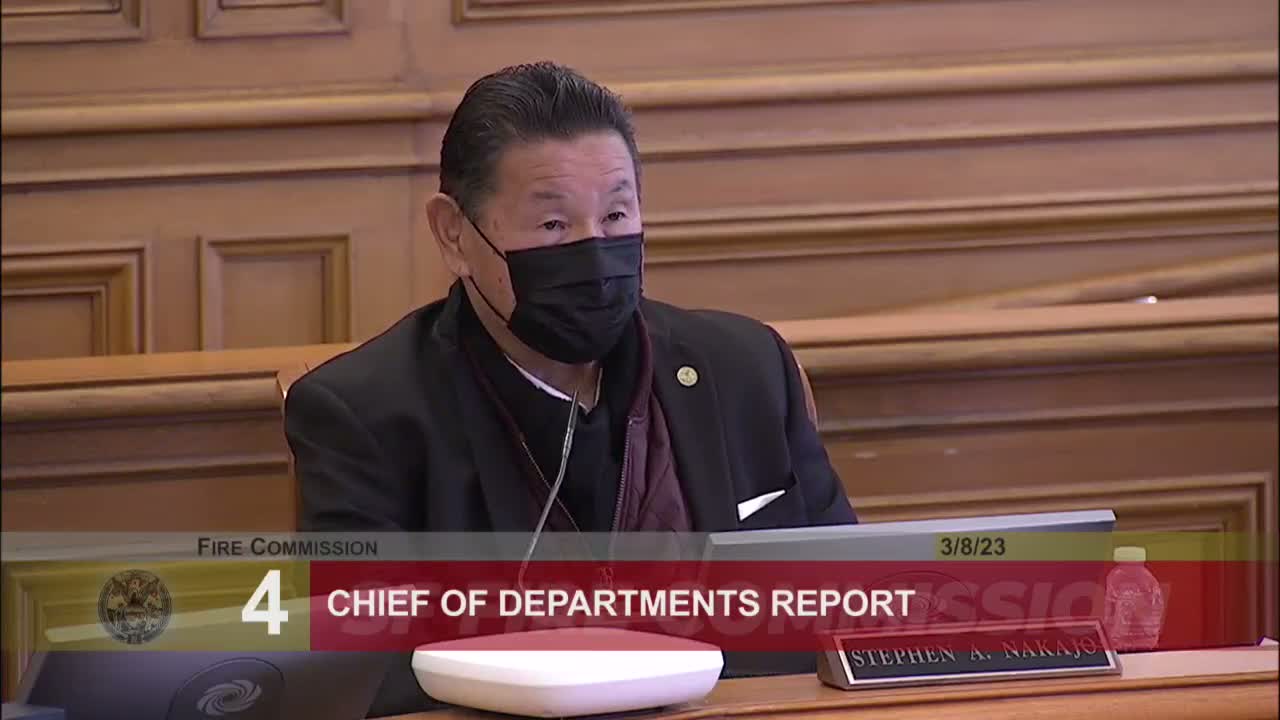
Deputy Chief (airport) Patrick Darcy briefed the Fire Commission on San Francisco International Airport operations, specialized equipment and training requirements on March 8.
Darcy said the airport division protects an area that covers roughly eight square miles and employs 105 airport-dedicated members who do not rotate out of airport duty. "Our response area there is 8 square miles," Darcy said. He described three airport fire stations, 12 staffed apparatus, specialized crash trucks (Oshkosh Stryker models) that carry large quantities of water and foam and under-truck sprinklers, and mass-casualty units that can hold medical supplies for hundreds of patients.
Darcy emphasized the intensive training and FAA inspection regime for airport crews — initial qualification requires about 40 hours of airport-specific training plus recurrent training across dozens of disciplines. He also outlined operational capabilities including watercraft for Bay rescues and a driving simulator used to certify crash-truck drivers.
On firefighting foam, Darcy said airports must transition from PFAS-containing AFFF to FAA-approved fluorine-free foam when specs and products are released; the airport will fund rig decontamination and disposal. He also described a bike-medic program staffed two-per-shift in terminals that reduces response times inside terminals to about a minute.
What happens next: the airport division will continue recurrent FAA inspections and roll out foam-transition preparations as FAA specifications and vendor products become available.