Get Full Government Meeting Transcripts, Videos, & Alerts Forever!
Get email alerts on the Response Time topic
No spam. Unsubscribe anytime.
Fire officials warn street redesigns and driverless cars are slowing emergency response times
Summary
San Francisco fire officials told the Fire Commission that recent street changes tied to Vision Zero, combined with traffic and autonomous vehicles, have contributed to longer response times — from a target of 4:30 to roughly 6:10 — and urged earlier coordination with MTA and city agencies.
San Francisco fire officials told the Fire Commission that changes to street configurations and the presence of driverless vehicles are making it harder for engines and ambulances to reach emergencies within department targets.
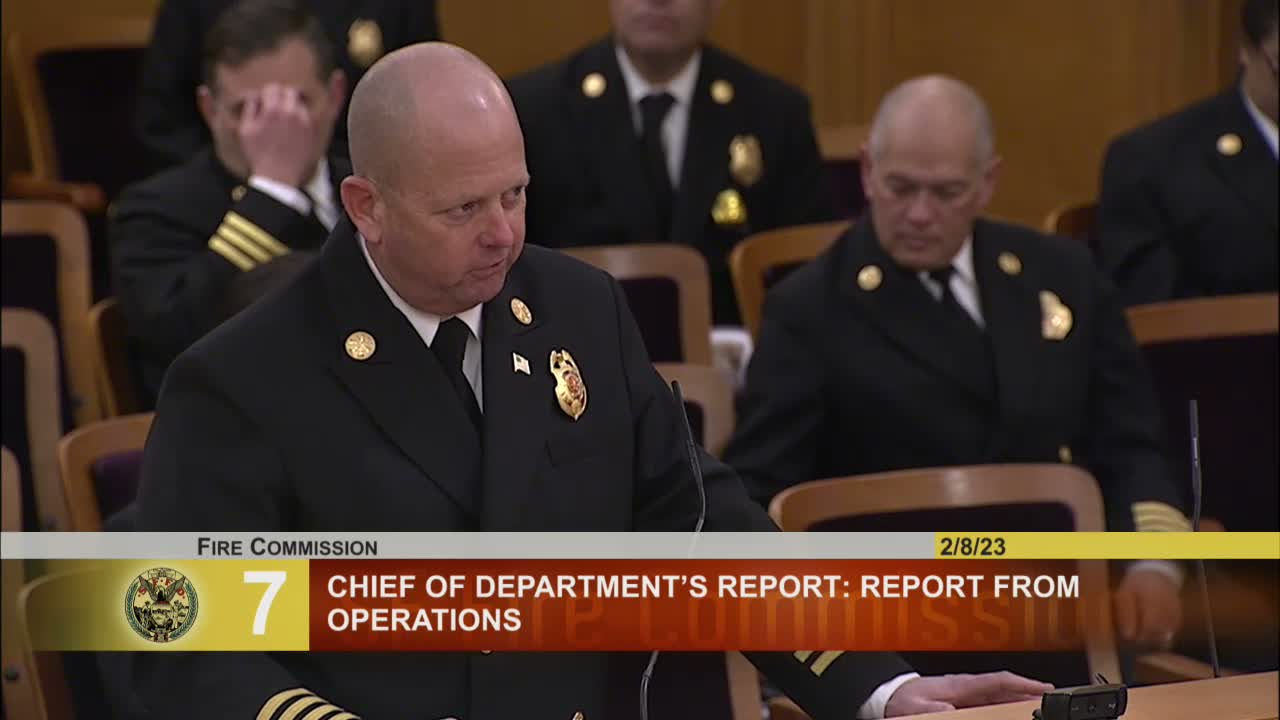
Deputy Chief Robert Postel and Chief Janine Nicholson described a series of recent multi-alarm fires — including a Jan. 13 second-alarm fire at 3017 Twentieth Street and a Jan. 22 second-alarm at 1312 Hayes Street — and linked some increases in response time to narrower or closed streets and other downtown congestion. "Anytime we narrow beyond that 26 foot width ... it severely hampers our ability to get to these buildings," Postel said, citing access standards for buildings three stories or greater. He said department response-time performance has deteriorated from a target of 4 minutes, 30 seconds to as high as about 6 minutes, 10 seconds in some measures.
Chief Nicholson and Postel said the department has asked the Municipal Transportation Agency for earlier notice of street projects and is funding a deeper study — paying half the cost — to compare corridors where changes have occurred with similar streets that have not been altered. "We want to be the first to find out," Nicholson said, arguing for a seat at the table when street treatments are planned.
Commissioners pressed for clarity about the causes and magnitude of the delay. Commissioner Marcy Frazier described heavy morning congestion on Market Street and said she could see how a rig might be unable to pull over. "There's nowhere for these rigs to go," she said. Postel and Nicholson acknowledged multiple factors may be involved, including traffic patterns and ride-hailing vehicles, and said they have commissioned further analysis.
The department also described operational risks caused by autonomous (driverless) cars. Postel and other staff recounted incidents in which driverless vehicles failed to move out of the way of a fire scene or attempted to drive into a scene. "There was hose on the street ... they couldn't stop it," Postel said. Staff said they report those incidents to city teams and to the California DMV, which licenses driverless operations, and that companies have petitioned to expand vehicle deployments.
Fire officials said preserving access for emergency operations remains a priority alongside Vision Zero traffic-safety goals and called for improved interagency coordination so street changes do not unduly impede emergency response.