Get Full Government Meeting Transcripts, Videos, & Alerts Forever!
Get email alerts on the Community Paramedicine topic
No spam. Unsubscribe anytime.
SFFD expands community paramedicine — testing stroke headband, offering buprenorphine after reversals and seeking funds for mass‑evacuation buses
Summary
Deputy Chief Sandra Tong reported the department is piloting the MIND Rhythm stroke‑detection headband, has used two donated Muni buses for a recent mass evacuation in Oakland and is offering buprenorphine to overdose survivors while pursuing poison‑control training to enable direct field administration.
Deputy Chief Sandra (Sandy) Tong told the commission that EMS and community paramedicine work is expanding with several operational pilots and research efforts. Tong said EMS averaged about 350 responses per day in October (a ~7% increase year‑over‑year) and the department added 60 FTEs to ambulance staffing, increasing daily shifts and reducing ambulance availability strain.
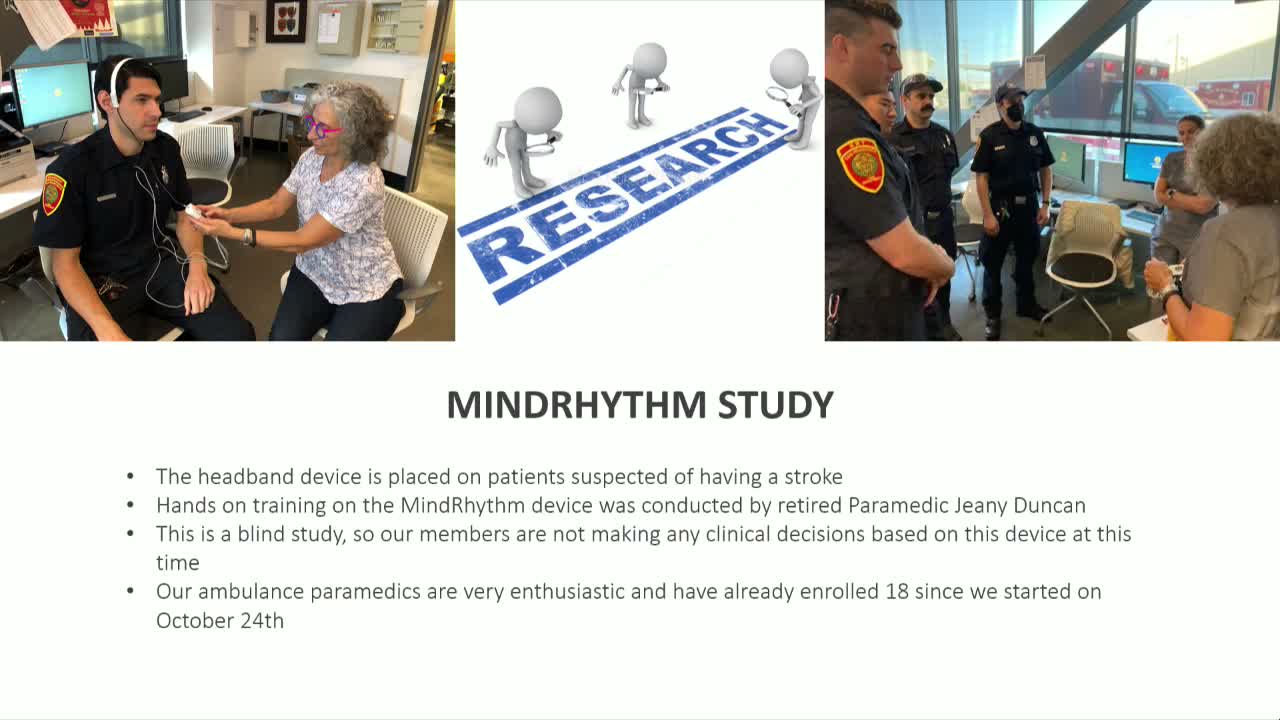
One trial the department began in October is the MIND Rhythm study, a headband device placed on patients suspected of having a stroke to help detect large‑vessel occlusions so crews can route them to comprehensive stroke centers. Tong said UCSF clinician‑researcher Dr. Wade Smith trained staff on device placement and data entry as part of the study.
Tong also described a regional mutual‑aid deployment: two 1998 Muni buses retrofitted to carry litters and patients were used to evacuate elderly residents from a senior assisted‑living facility in Oakland. "These buses...are an important asset for the San Francisco city and region," Tong said, but added that the vehicles are old and the department will seek funding to replace them because Muni cannot support long‑term maintenance.
On overdose response, chiefs described an initiative to offer buprenorphine after Narcan reversals. Currently community paramedics escort people to a provider and pharmacy for a loading dose and prescription. "What we're trying to do...is be able to administer the buprenorphine ourselves," a chief said, noting poison‑control training for pharmacists and providers would be required before field administration could occur.
The commission also heard data from student analysts indicating community paramedicine visits reduced 'unable to locate' outcomes and decreased non‑emergent ambulance transports, returning ambulances to service faster. Commissioners and chiefs discussed "moral injury" — the psychological toll when members feel they cannot help clients because of system limitations — and said the department would pursue training and support structures.
What happens next: the department will continue MIND Rhythm enrollment and training, look for replacement funding for mass‑evacuation buses, and pursue poison‑control and training steps necessary to expand buprenorphine availability in the field.