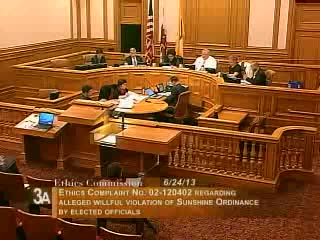
Ethics Commission: Arts Commission failed to provide required redaction notice but may withhold addresses; mixed rulings in Sunshine referral
Loading...
Summary
The Ethics Commission found the Arts Commission failed to follow procedural redaction-notice requirements and that Arts Commission staff did not timely respond to an immediate disclosure request, but concluded the redacted contact information need not be disclosed and found no willful failure to comply with the Task Force order.
The San Francisco Ethics Commission issued a mixed ruling on a Sunshine Ordinance referral from the Sunshine Ordinance Task Force involving the San Francisco Arts Commission’s handling of speaker-card redactions.
The commission found that Kate Patterson, the Arts Commission’s director of communications, did not respond to an immediate disclosure request in a timely manner and that the Arts Commission failed to comply with the procedural notice and justification requirements in section 67.26 when it provided redacted speaker cards. At the same time, the Ethics Commission concluded on the record before it that the respondent had met the burden to establish that the redacted information (personal addresses and emails) need not be publicly disclosed, and it recorded that there was no willful failure to comply with the Task Force’s April 5, 2012 order under section 67.34.
Kate Patterson acknowledged the late response in testimony and apologized: “We don't have a good excuse. It was simply overlooked, and it was overlooked by me specifically,” she told commissioners. The Arts Commission said it redacted personal addresses and other contact information after consulting the city attorney and cited privacy protections under the California Constitution and the Public Records Act. Patterson said the commission has revised the speaker card so it no longer requests home addresses and added a disclaimer allowing anonymous public comment.
Complainants and public speakers said they discovered white paper or correction tape covering addresses when they inspected original cards and argued the redactions were not properly documented or justified. Peter Warfield of Library Users Association described receiving photocopies and later seeing originals with what he characterized as concealed redactions, and told the commission, “when I first got the material, it was electronic...when I came to the office to inspect the speaker cards, they tried to fool me by giving me photocopies...white pieces of paper pasted over perhaps half of the cards.”
After deliberation the commission: (1) found a violation of the notice-and-justification requirements of section 67.26 for the redactions, (2) found Ms. Patterson failed to respond timely to an immediate disclosure request under section 67.25A, (3) concluded that on the evidence before it the redacted records need not be publicly disclosed in unredacted form, and (4) found no willful failure to comply with the Task Force’s order under section 67.34. Commissioners discussed whether this ruling creates a broader precedent for other city bodies and urged clearer documentation standards for redactions going forward.
The commission instructed staff as appropriate on how the findings should be reflected in the record. The Ethics Commission’s minutes record both the procedural defects in how the Arts Commission documented redactions and the substantive conclusion that the redacted material was appropriately withheld on the facts presented.