Get Full Government Meeting Transcripts, Videos, & Alerts Forever!
Get email alerts on the Public Records topic
No spam. Unsubscribe anytime.
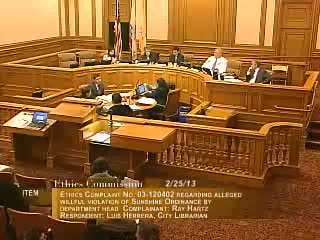
Commission declines willful finding against Rec & Park general manager in disputed deletion of emails
Summary
After hours of public testimony alleging Recreation & Park staff and allies sought to influence a Commonwealth Club panel and then failed to preserve responsive emails, the Ethics Commission voted that evidence did not support a willful Sunshine violation of the specified sections.
The Ethics Commission heard a lengthy referral on Dec. 5 alleging that senior officials at the Recreation and Park Department pressured a private Commonwealth Club forum about Golden Gate Park, then failed to produce related emails in response to a Sunshine request.
Complainant George Wooding described a coordinated campaign he says sought to change the panel, add city‑friendly speakers and discourage dissenting voices; he said documents he later obtained from the Commonwealth Club showed Rec & Park staff and outside lobbyists had exchanged emails urging changes and that the department did not produce those records when he filed a request. “This is a case about how the Recreation and Park Department abused the First Amendment free speech rights of private citizens and then tried to hide the abuse by deliberately deleting all public records,” Wooding said.
Phil Ginsberg, Rec & Park general manager, denied wrongdoing. He told commissioners he worked with the city attorney’s office and the Department of Telecommunications and Information Services to search for responsive records, that many of the emails were not maintained as departmental records under the department’s retention schedule, and that his SFGov account had no responsive messages. Ginsberg also said the department had responded to hundreds of public records requests annually and that when DTIS and IT were asked to search backup data they did so.
Public commenters and former Task Force members pressed the commission to treat the case as a serious failure of record preservation, arguing that backup tapes and departmental archives should have been searched sooner. Legal advisers and staff described administrative code retention categories (admin code §8.1 and the department’s retention policy) that guide whether an email is a current record or a non‑retained communication.
Commission deliberations focused on whether the failure to find or to preserve messages amounted to a willful violation given conflicting guidance from the city attorney and unclear citywide policy on searching backup tapes. Several commissioners said they were troubled by the department’s practices but concluded the evidence did not support a willful finding in this referral. The commission voted to find no willful violation of the cited sections and recommended follow‑up via staff letters and review of record‑retention and backup‑search procedures.
The commission also highlighted the policy question of whether the city should adopt clearer, citywide standards requiring when departments must search backup tapes or DTIS archives in response to Sunshine requests.